.svg)
Is Klaviyo CDP a Real Customer Data Platform? Our Verdict
.avif)
Is Klaviyo CDP a Real Customer Data Platform? Our Verdict
Klaviyo CDP, now the Klaviyo Data Platform (KDP), is a capable customer data layer for Klaviyo users but not a full standalone customer data platform. Every Klaviyo account includes standard KDP features: profiles, segments, predictive analytics, integrations and data storage. Advanced KDP, formerly Klaviyo CDP, is a paid upgrade on top that adds no-code data transformation and data warehouse syncs. Klaviyo matches profiles deterministically on shared identifiers and prices Advanced KDP on total profiles, not active ones.
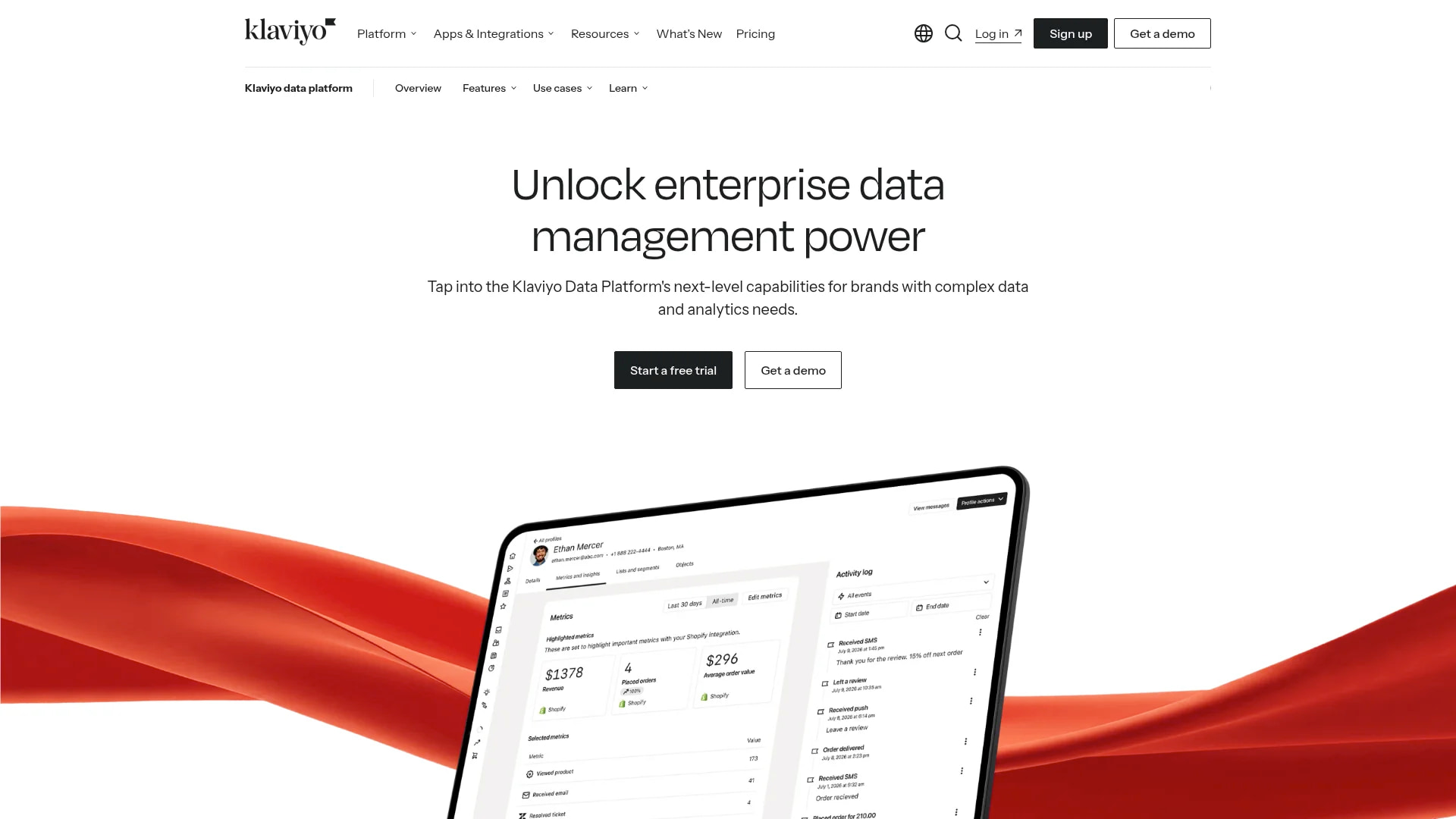
Klaviyo's Advanced KDP product page comparing standard and Advanced Klaviyo Data Platform features
The question usually lands after a brand gets pitched a standalone CDP. Is it already paying for one inside Klaviyo? Partly, and we say that as a Klaviyo Master Platinum Partner that likes the platform.
What Is Klaviyo CDP, Now the Klaviyo Data Platform?
Klaviyo announced the Klaviyo Customer Data Platform on 15 August 2023 as a tool to transform and clean data, run advanced reporting and sync Klaviyo data with other systems.
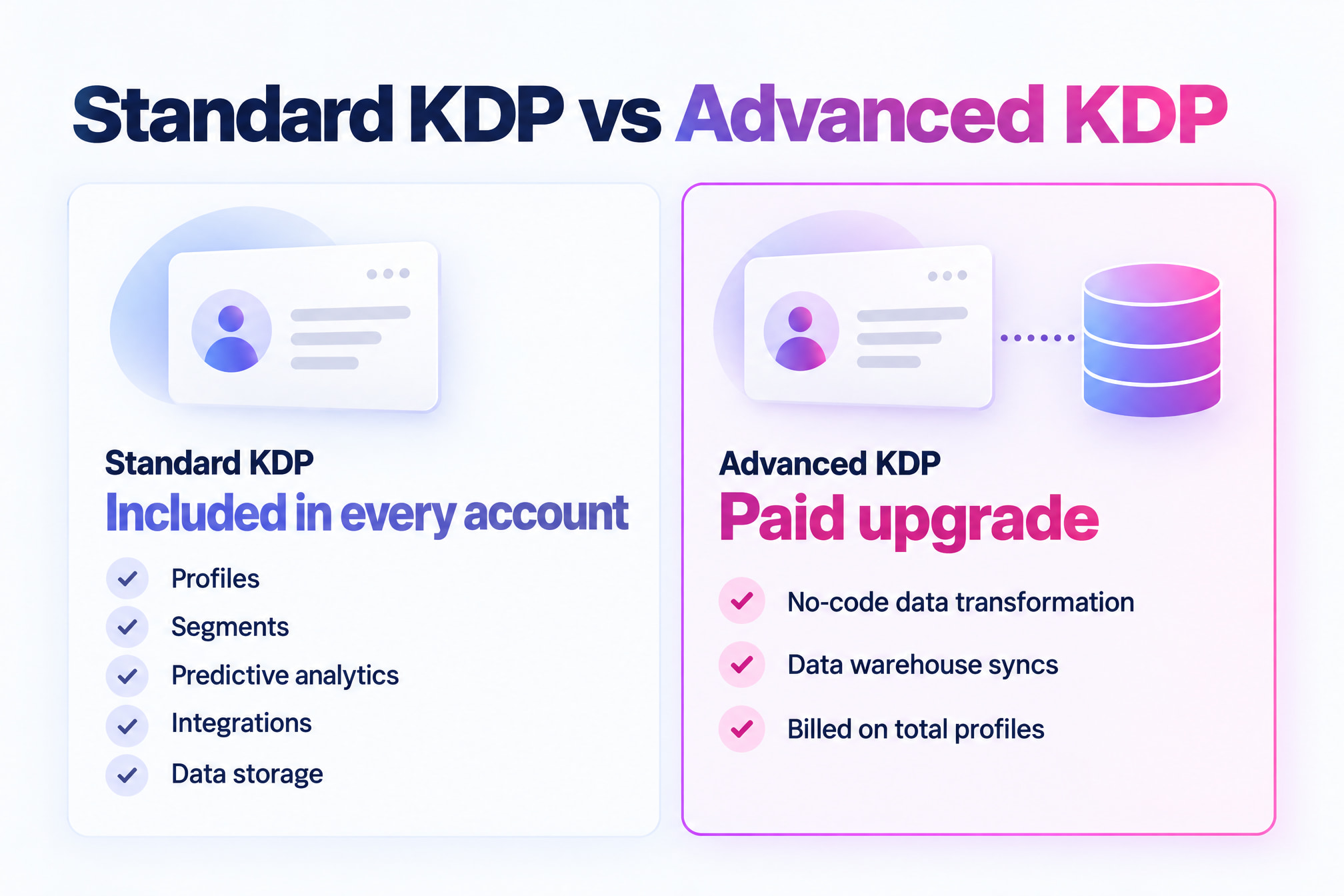
The original 2023 Klaviyo Customer Data Platform was renamed Advanced KDP, so ask which one someone means.
Then the naming shifted. The original CDP became Advanced KDP, and the basics every account already had became standard KDP. So when someone says "Klaviyo CDP" today, ask which one they mean.
The positioning moved again in 2026. Klaviyo's Q2 2026 results describe the company as an "autonomous B2C CRM" rather than a CDP. That's telling. Klaviyo wants to own the whole customer relationship, and the CDP label was only ever part of that.
The Seven Tests Any Real Customer Data Platform Must Pass
The CDP Institute's RealCDP certification tests a customer data platform against seven capabilities, which makes it the fairest yardstick for Klaviyo. Under the CDP Institute's RealCDP certification criteria, a real CDP must:
- Take in data from any source, structured, semi-structured or unstructured
- Keep full detail
- Store data as long as you need, subject to privacy rules
- Build unified customer profiles of identified people
- Share data with any system
- Respond in real time
- Govern data in line with privacy and security rules
The bar has risen. When the CDP Institute launched its vendor certification programme, it listed five requirements. Now it's seven.
Klaviyo sits in the CDP Institute's vendor directory. A listing isn't certification, though, and plenty of comparisons blur the two. Our explainer on how CDPs change email marketing covers the fundamentals behind these tests.
How Klaviyo Builds Unified Customer Profiles
Klaviyo builds unified customer profiles with deterministic identity resolution, merging profiles that share an exact identifier such as an email address.
That's clean but narrow. According to Klaviyo's identity resolution documentation, probabilistic matching on name and address was, as of September 2025, only planned "in the future". So an anonymous visitor with no shared identifier stays anonymous. No stitching. No guesswork.
Customer data reaches those profiles through more than 350 integrations Klaviyo advertises. Each one only adds to the single customer view if the record carries a matchable identifier.
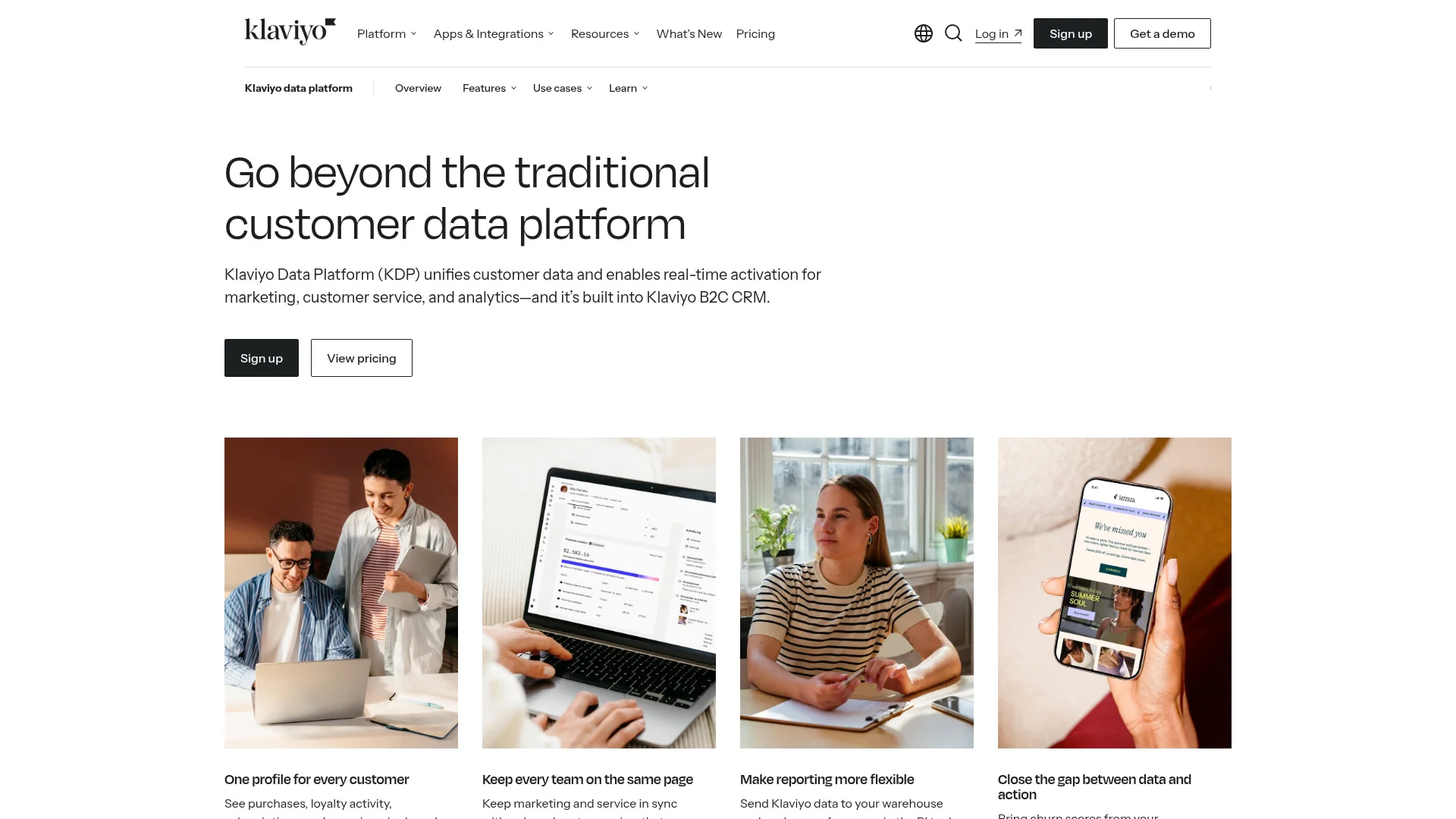
Klaviyo Customer Data Platform overview page highlighting its 350+ integrations
So capture identity early. Quizzes, preference centres and sign-up forms earn zero-party data and an email address in one go. Our zero-party data playbook for D2C brands covers the build.
Segmentation and Predictive Analytics Come Free in Standard KDP
Segmentation and predictive analytics are standard Klaviyo Data Platform features, available to every Klaviyo user without paying for Advanced KDP, according to Klaviyo's comparison of standard and Advanced KDP.
This is where we'd put effort first. Sharper behavioural and predictive segments will lift retention sooner than any new data tool.
Start with behaviour. Recent buyers, lapsed buyers, high-value repeaters. Feed each group into its own flow.
Then personalise content per segment across email and SMS. Our guide to behaviour-based segmentation in Klaviyo walks through the setup.
Advanced KDP Data Transformations: Clean Data Without Developers
Advanced KDP includes no-code data transformation tools that let marketers clean profile properties without writing code. Klaviyo's guide to profile property transformations lists standardisation rules, such as making country names consistent. A Merge transformation combines up to 10 custom profile properties into one.
Sounds dull. It isn't. If one form captures "UK", another "United Kingdom" and a third "GB", your country segmentation is wrong three different ways.
Before building anything new, audit your ten most-used profile properties. Standardise the messy ones and merge the duplicate fields your integrations created. Skip it, and every personalisation block built on those fields inherits the mess.
Advanced KDP Warehouse Sync: Where the Upgrade Earns Its Keep
Advanced KDP's data warehouse import connects directly to Snowflake, BigQuery, Redshift or Databricks. Klaviyo's data warehouse import documentation confirms it brings in tables or views of profile and event data.
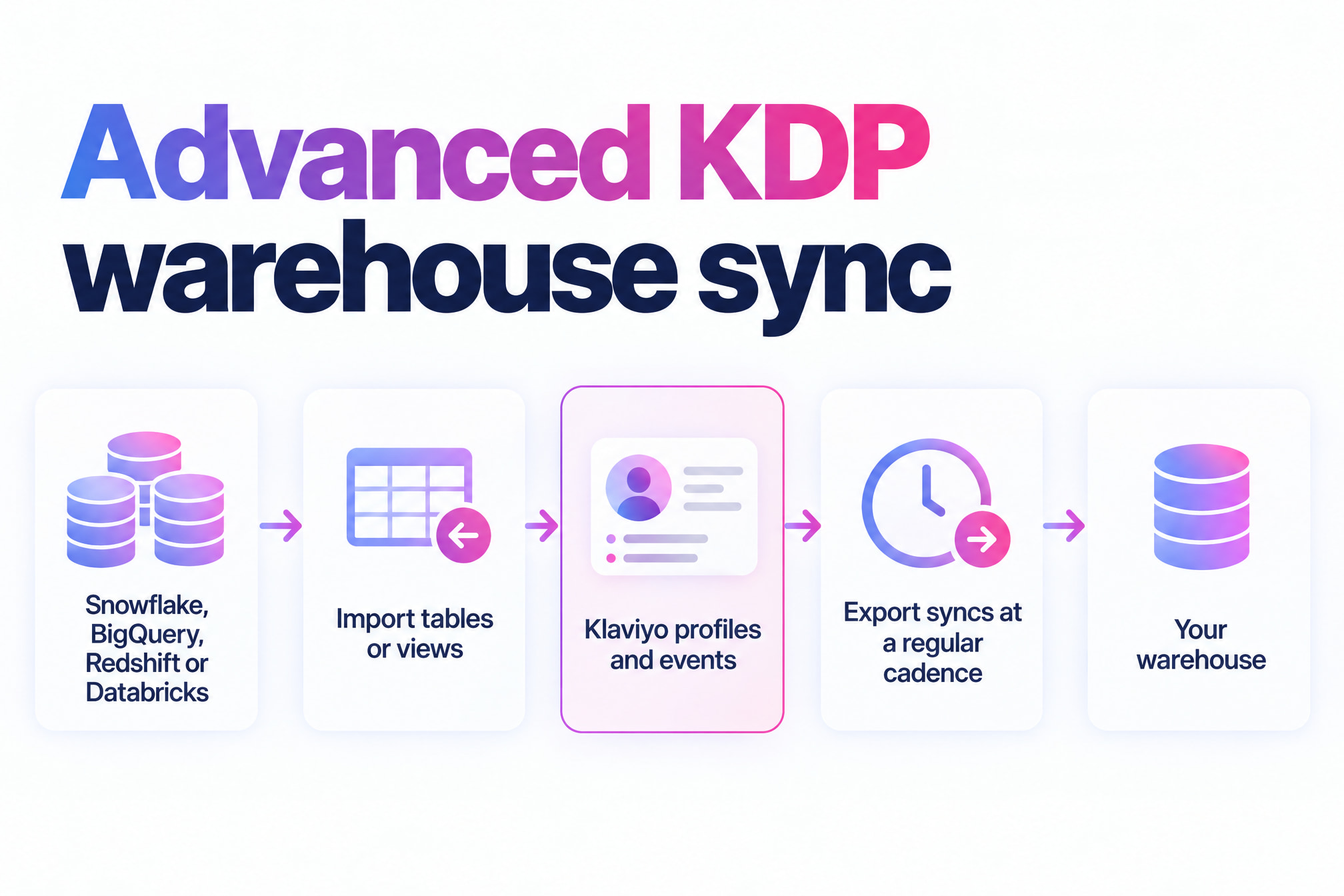
Scheduled exports suit reporting, but systems that must react the moment a Klaviyo event fires need real-time options.
Traffic goes both ways. Advanced KDP export syncs send profile and event data to your warehouse at a regular cadence.
Regular cadence is not real-time. Fine for reporting. Less fine if another system has to react the moment a Klaviyo event fires.
Your developers may also rely on webhooks, custom objects, custom metrics or the group membership API. Check each one against Klaviyo's current documentation for your plan before you sign.
Four Advanced KDP Use Cases Worth Paying For
Advanced KDP is worth the upgrade when a brand already holds valuable customer data outside Klaviyo and wants it driving lifecycle marketing. Four use cases make the case:
- Warehouse-fed segments: import loyalty tiers or product margin data so segments reflect everything the business knows.
- Clean data before personalisation: standardise properties so dynamic content stops showing blanks and odd formatting.
- Channel data in BI: export email and SMS engagement so analysts see retention next to revenue.
- A tidier single customer view: merge scattered properties into one field your flows can trust.
No warehouse and no data team? Then you probably don't need Advanced KDP yet. Standard KDP will carry you further than most brands push it.
Klaviyo CDP Pricing: Why Total Profiles Change the Maths
Klaviyo CDP pricing for Advanced KDP is based on total profiles in the account, whatever their marketing status. The base email plan uses active profiles instead, per Klaviyo's Advanced KDP billing guide.
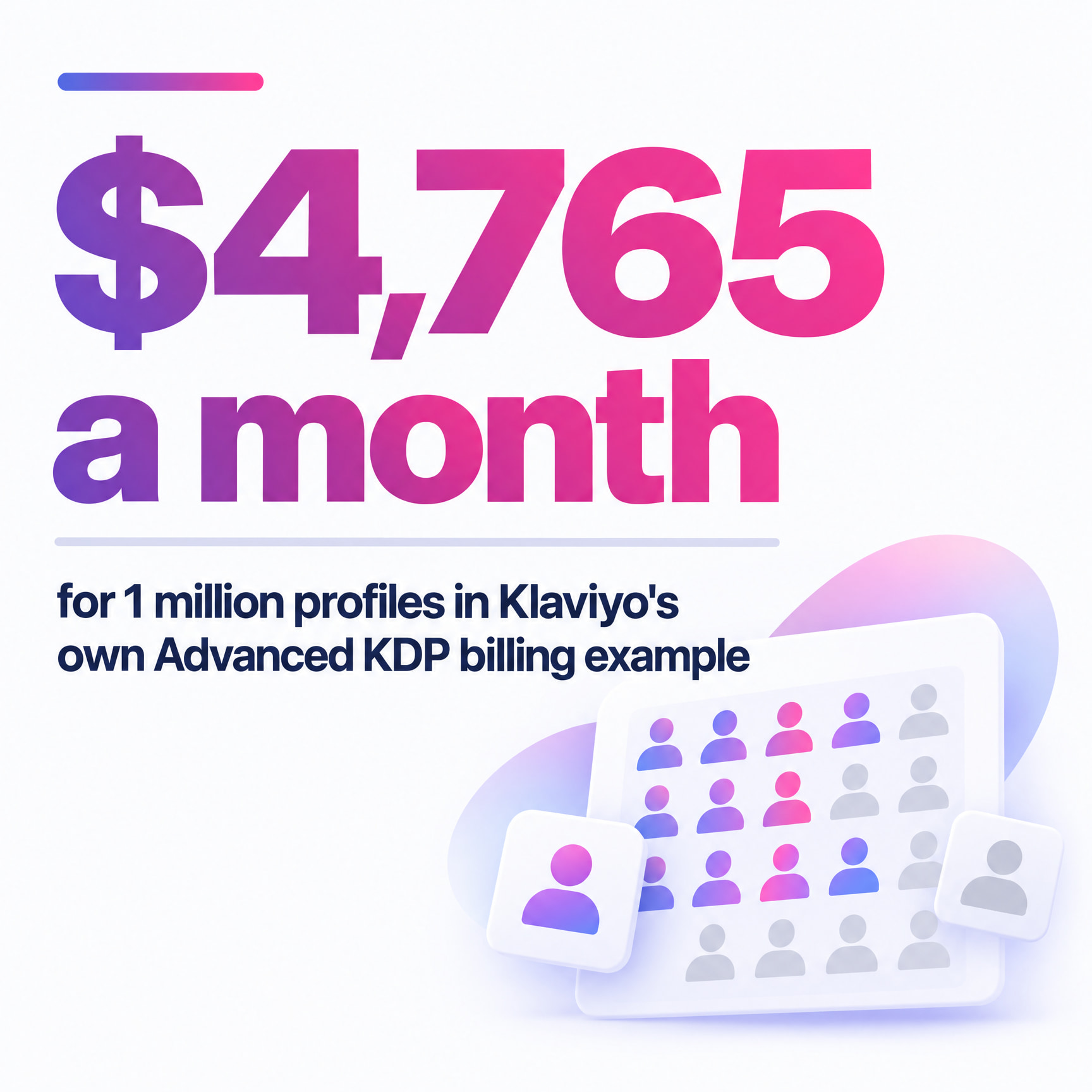
This is an illustration, not a rate card. It sits on top of your email plan and counts every profile, not just active ones.
Read that twice. Profiles you'd never email still count toward the Advanced KDP bill.
For scale, Klaviyo's own billing example shows $4,765 a month for 1 million profiles. It's an illustration, not a rate card. And it sits on top of your email plan.
Clean house before you upgrade. Delete profiles you'll never market to and the total drops. Our Klaviyo review for 2026 covers pricing alongside the wider pros and cons.
Quick Answers on Klaviyo CDP and CDPs in General
What is a CDP used for?
A customer data platform unifies customer data from multiple sources into persistent profiles. Brands use that single customer view to power segmentation and personalisation across channels.
What is a CDP vs a CRM?
A CDP builds unified profiles from many data sources, while a CRM manages the relationship and interactions with each customer. Klaviyo now sells itself as a B2C CRM, with its data platform underneath.
What are the top CDP platforms?
The CDP Institute's 2026 Industry Update tracks 217 CDP vendors and $2.9B in industry revenue. Any top ten is a shortlist from a crowded field. Our comparison of the best CDPs for email marketing narrows it down.
Why is Klaviyo so expensive?
Klaviyo costs climb with profile counts, and Advanced KDP bills on every profile. Klaviyo is also moving upmarket. It ended Q2 2026 with 4,477 customers paying $50K+ ARR, up 36% year over year, making up about 40% of ARR.
Pricing follows the customers. Bigger brands are where Klaviyo's growth is coming from.
Our Verdict on Klaviyo CDP: Strengths, Weaknesses and Fit
Klaviyo CDP is a real customer data platform for teams marketing inside Klaviyo, but it trails standalone CDPs on identity resolution and real-time data sharing.
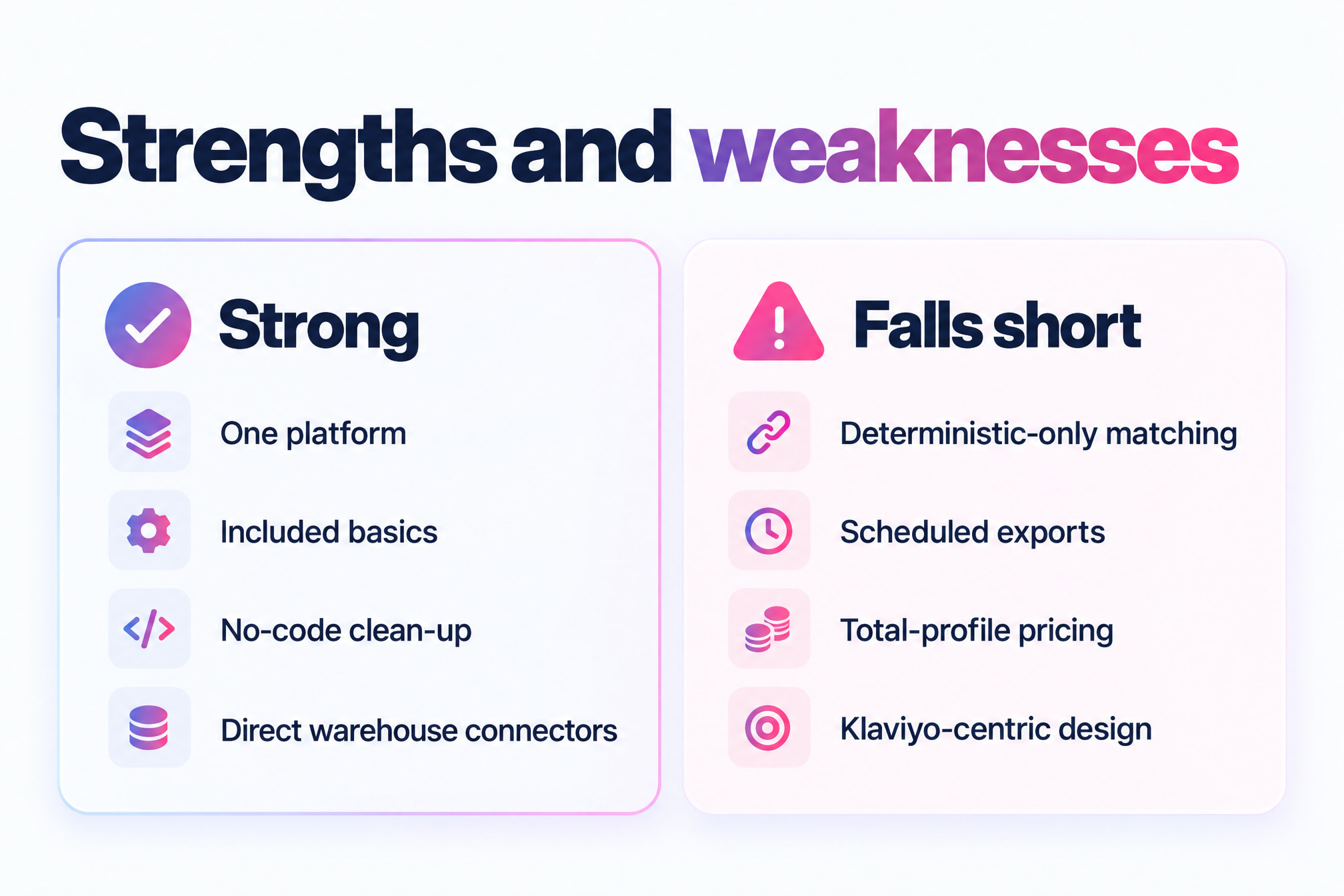
It trails standalone CDPs on identity resolution and real-time sharing, but suits brands marketing mainly inside Klaviyo.
Where Klaviyo CDP is strong
The strengths that matter most for ecommerce teams are:
- One platform: data and activation live together, so there's no second tool to sync and maintain.
- Included basics: profiles, segments and predictive analytics come with every account.
- No-code clean-up: marketers standardise and merge properties themselves.
- Direct warehouse connectors: Snowflake, BigQuery, Redshift and Databricks.
Where Klaviyo CDP falls short
The weaknesses to weigh before you commit are:
- Deterministic-only matching: anonymous visitors stay unresolved until they share an identifier.
- Scheduled exports: warehouse syncs run on a cadence, not in real time.
- Total-profile pricing: the Advanced KDP bill counts every profile.
- Klaviyo-centric design: it's strongest when Klaviyo is your main channel.
Who should buy Advanced KDP
Advanced KDP suits ecommerce and D2C brands running lifecycle marketing through Klaviyo with customer data already in a warehouse. Mid-market brands without one rarely need a standalone CDP. Standard KDP covers the core.
Klaviyo isn't a risky bet either. Klaviyo's Q2 2026 filing shows revenue of $370.6M, up 26%, with net revenue retention of 109%. Existing customers are spending more over time.
More than 205,000 brands used Klaviyo at the end of Q2 2026. You won't struggle to find people who know it.
Your first step today: open your profile properties and count how many ways country is written. More than one? Fix that before spending a penny on Advanced KDP. Enchant is Klaviyo's 2026 EMEA UK & Ireland Partner of the Year, so book a call and we'll tell you straight whether the upgrade earns its keep.