.svg)
Ecommerce Email Marketing: The 2026 Playbook for D2C Brands
.avif)
Email remains the most profitable channel for D2C brands. Full stop.
Growing DTC brands generate between 25 and 40 percent of their total revenue from email marketing. Not from paid social. Not from influencer partnerships. From email.
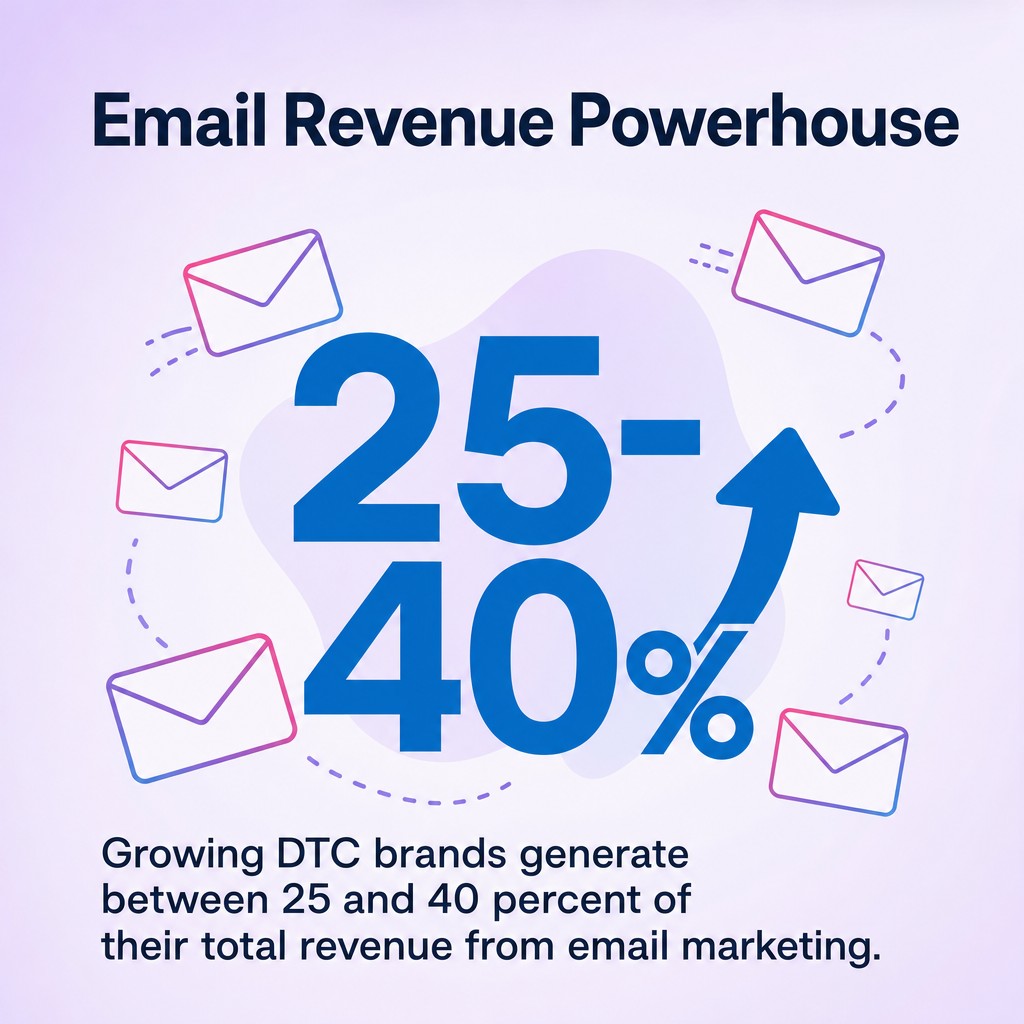
That number should wake up any brand still treating email as an afterthought or batch-and-blast newsletter channel.
The problem? Most D2C brands are still running their email programmes the way they did in 2019. Same welcome series. Same abandoned cart reminder. Same monthly newsletter nobody opens. They've got the infrastructure, but they're not using it properly.
This playbook shows you what actually works now. We'll walk through the automation flows that drive revenue, the segmentation logic that lifts conversion rates, the lifecycle mapping that turns one-time buyers into repeat customers, and the multi-channel orchestration that makes retention predictable rather than accidental.
We work with D2C brands across luxury, wellness, retail, and subscriptions. These are the exact strategies we're implementing with clients like Self Portrait (390% revenue increase from email), Bohomoon (over 1000% email revenue growth across three years), and Neal's Yard Remedies.
What Ecommerce Email Marketing Actually Means in 2026
Ecommerce email marketing is the practice of using email as a retention and revenue channel within an online store operation.
It's not broadcast marketing. It's lifecycle communication.
The shift happened when ESPs added behavioural triggers and customer data platforms made real segmentation possible. Now email sits at the centre of your customer retention system, connecting purchase history, browsing behaviour, engagement patterns, and zero-party data into personalised messaging sequences.
Why Email Still Outperforms Every Other Channel
The economics are simple. Email marketing delivers between $36 and $45 for every dollar spent.

Paid social costs more every quarter. Organic reach keeps declining. Email remains a permission-based, owned channel where you control the message, the timing, and the customer relationship.
Three structural advantages explain why email works:
- Direct access to your customer's inbox without platform algorithm interference
- Behavioural triggers that send the right message at the exact moment someone needs it
- Cost efficiency at scale once your flows are built and tested
The brands treating email as a newsletter channel are leaving 30-40% of potential revenue on the table.
The Multi-Channel Reality
Email doesn't operate alone anymore.
Multi-channel orchestration strategies increase conversion rates by up to 63 percent compared to email-only strategies. That means email, SMS, push notifications, and in-browser messages working together across the customer journey.

Your welcome flow should span all four channels. Your abandoned cart recovery should know which channel gets the best response for each customer segment. Your re-engagement campaigns should test different channel combinations.
This isn't about spamming people across multiple channels. It's about using the right channel at the right time based on customer preference and engagement history.
The Five Campaign Types That Drive Ecommerce Revenue
Most D2C brands run two types of email campaigns: newsletters and promotions. That's not a strategy. That's just noise.
Here are the five campaign types you actually need, built around customer lifecycle stages rather than your marketing calendar.
Welcome Series: Your First Impression at Scale
The welcome series converts browsers into buyers. Subscribers who complete an effective welcome series convert to first purchase at rates between 2.19 and 4.01 percent.

Your welcome series should accomplish four things across 5-7 days:
- Establish brand story and positioning (email 1, immediately after signup)
- Showcase hero products with social proof (email 2, 24 hours later)
- Remove friction with shipping, returns, and guarantee information (email 3, 48 hours)
- Create urgency with first-purchase incentive expiry (email 4-5, days 4-7)
Multi-channel welcome flows combine email with SMS and push notifications. Email handles storytelling. SMS delivers time-sensitive offers. Push notifications remind app users about items they viewed.
At Enchant, we build welcome series that span email, SMS, and push across the first week, with each message serving a specific conversion goal.
Abandoned Cart Recovery: The Revenue You're Already Losing
Cart abandonment is not a problem. It's an opportunity.
Abandoned cart emails generate an average conversion rate of 8.17 percent. That's higher than most cold acquisition campaigns by an order of magnitude.
Your cart recovery flow needs three messages:
- Email 1 (1 hour after abandonment): Simple reminder with product images and direct cart link
- Email 2 (24 hours): Add urgency with inventory levels or social proof
- Email 3 (48-72 hours): Final push with incentive only if first two emails didn't convert
The third email is where most brands make mistakes. Don't default to discounting. Test free shipping, extended returns, or payment plan options first. You're training customers that waiting pays off if you always offer discounts.
For high-value carts, add SMS to your second reminder. For app users, push notifications outperform email on mobile devices.
Post-Purchase: Turning Buyers into Repeat Customers
Post-purchase emails don't just confirm orders. They set up the next purchase.
Your post-purchase sequence should include:
- Order confirmation (transactional, immediate)
- Shipping notification with tracking (transactional, when item ships)
- Delivery confirmation (transactional, when delivered)
- Product education (3 days after delivery)
- Review request (7-14 days after delivery, depending on product type)
- Replenishment or complementary product recommendation (timing varies by product)
The education and review emails are where retention actually happens. Customers who engage with post-purchase content buy again at 3-4x the rate of customers who only receive transactional confirmations.
For consumable products, your replenishment timing needs to match actual usage patterns. Track time-to-second-purchase by product SKU and set your automation triggers accordingly.
Browse Abandonment: Catching Interest Before It Disappears
Browse abandonment captures people who viewed products but never added them to cart.
The conversion rates are lower than cart abandonment (1-2% vs 8%), but the volume is much higher. Most site visitors browse without buying. That's normal behaviour, not a problem to solve.
Your browse abandonment flow should:
- Trigger after someone views 2+ products in the same category without purchasing
- Wait 2-4 hours before sending (not immediate like cart abandonment)
- Show the specific products they viewed with related recommendations
- Include social proof or reviews specific to those products
Don't send more than one browse abandonment email per session. If they come back and browse again, you can send another. But one abandoned session should not generate multiple emails.
Re-Engagement: Winning Back Dormant Customers
Re-engagement campaigns target customers who haven't purchased in 60-180 days (timing varies by industry and typical purchase frequency).
These campaigns should not lead with discounts. You're not bribing people to come back. You're reminding them why they bought from you in the first place.
Effective re-engagement sequences include:
- Product updates and new arrivals in categories they previously purchased
- Content showcasing how other customers use your products
- Request for feedback on why they stopped buying
- Incentive offer only if first three emails generate no response
Segment your dormant list by previous purchase behaviour. Someone who bought once needs a different message than someone who made five purchases before going quiet.
Building Your Email Marketing Automation Strategy
Strategy is not the same thing as tactics. Tactics are the individual flows and campaigns. Strategy is the framework that determines which flows to build, in what order, and how they connect.
Start With Your Customer Lifecycle Map
Before you build a single automation, map your customer lifecycle stages. Most D2C brands have five core stages:
Each stage needs different messaging, different offers, and different automation triggers. Treating all subscribers the same is why most email programmes underperform.
We help brands build customer lifecycle maps that connect email strategy to business objectives.
The 12-Month Strategic Roadmap
Your email programme should have a roadmap, not just a to-do list.
We structure client roadmaps in quarterly blocks:
Q1: Foundation Quarter
- Audit current programme and identify quick wins
- Implement core transactional flows (welcome, cart abandonment, post-purchase)
- Set up basic segmentation by lifecycle stage
- Establish baseline metrics for all flows
Q2: Optimisation Quarter
- A/B test core flows to lift conversion rates
- Add browse abandonment and re-engagement flows
- Implement dynamic content based on customer data
- Expand segmentation to include product affinity and engagement level
Q3: Growth Quarter
- Build product-specific replenishment flows
- Launch VIP and loyalty programme emails
- Add multi-channel orchestration (SMS, push, in-browser)
- Implement predictive behavioural targeting
Q4: Scaling Quarter
- Expand into advanced personalisation with AI-driven recommendations
- Build seasonal campaign frameworks
- Implement win-back campaigns for churned segments
- Audit deliverability and list hygiene
This phased approach prevents the "build everything at once" trap that overwhelms teams and delivers mediocre results across all flows.
Choosing Your Email Service Provider
Your ESP is the foundation of your entire email programme. Choose wrong and you'll hit limitations that require expensive migrations later.
For D2C ecommerce brands, three platforms dominate:
Klaviyo (our recommendation for most D2C brands)
Best for: Shopify stores, brands doing $500K-$50M annual revenue, teams that need advanced segmentation without technical resources.
Klaviyo's ecommerce focus means pre-built flows, native Shopify integration, and predictive analytics out of the box. The pricing scales with list size, which works well for growing brands.
HubSpot (best for omnichannel brands)
Best for: Brands selling D2C plus wholesale/B2B, companies that need CRM + marketing automation in one platform, teams managing complex customer journeys across multiple properties.
HubSpot's strength is connecting email to your full customer database, sales pipeline, and content management. The downside is complexity. You're buying an entire platform, not just an ESP.
Braze (enterprise multi-channel)
Best for: Brands with apps, companies sending billions of messages annually, teams that need sophisticated multi-channel orchestration across email, SMS, push, and in-app.
Braze excels at real-time personalisation and cross-channel journey orchestration. It's overkill for brands under $10M revenue, but essential once you need enterprise-scale messaging.
We're Klaviyo Master Platinum Partners and HubSpot Platinum Solutions Partners. We also work with Braze, Iterable, and Salesforce Marketing Cloud depending on client needs.
If you're unsure which platform fits your business, our ESP selection service evaluates your requirements against platform capabilities.
The Essential Automation Flows Every D2C Brand Needs
Automation is not about sending more emails. It's about sending the right email at the exact moment someone needs it, without manual intervention.
These seven automation flows form the foundation of every profitable ecommerce email programme.
Welcome Series (5-7 Emails Over 7 Days)
Already covered the strategy above. Here's the technical implementation:
Trigger: Form submission, newsletter signup, account creation, or first site visit with email capture
Timing:
- Email 1: Immediate (within 5 minutes)
- Email 2: 24 hours after signup
- Email 3: 48 hours (day 2)
- Email 4: Day 4
- Email 5: Day 7
Exit conditions: Customer makes first purchase (moves to post-purchase flow)
Include SMS on day 3 and push notification on day 5 for customers who installed your app but haven't purchased yet.
Abandoned Cart Flow (3 Emails Over 72 Hours)
Trigger: Customer adds product to cart and leaves site without purchasing
Timing:
- Email 1: 1 hour after cart abandonment
- Email 2: 24 hours after abandonment
- Email 3: 48-72 hours (test both and use whichever converts better)
Exit conditions: Customer completes purchase
Personalisation: Show exact cart contents with product images. Include stock levels if inventory is low. Add reviews or social proof for high-value items.
For carts over your average order value, send SMS at the 24-hour mark in addition to email. Test this threshold by segment. Your VIP customers might respond better to SMS at different cart values than new customers.
Post-Purchase Flow (5-7 Emails Over 30-60 Days)
Trigger: Order confirmation
Timing:
- Order confirmation: Immediate
- Shipping notification: When order ships
- Delivery confirmation: When delivered
- Product education: 3 days post-delivery
- Review request: 7-14 days post-delivery
- Replenishment or cross-sell: 30-60 days (varies by product)
Exit conditions: Customer makes second purchase (moves to active customer segment)
Product education is where most brands miss opportunity. Don't just say "thanks for your order." Show customers how to get maximum value from what they bought. Include care instructions, usage tips, styling ideas, or recipe suggestions depending on your product category.
Browse Abandonment Flow (1-2 Emails Over 48 Hours)
Trigger: Customer views 2+ products without adding to cart
Timing:
- Email 1: 2-4 hours after browsing session ends
- Email 2 (optional): 24 hours if no response to first email
Exit conditions: Customer returns to site or adds product to cart
Keep the product selection focused. Show the 2-4 products they spent the most time viewing, plus 2-3 related items. Don't dump your entire catalogue in a browse abandonment email.
Re-Engagement Flow (3-4 Emails Over 30 Days)
Trigger: Customer hasn't purchased in 90-180 days (adjust based on your typical purchase frequency)
Timing:
- Email 1: Day 1 (new products in their favorite categories)
- Email 2: Day 7 (customer stories or use cases)
- Email 3: Day 14 (feedback request)
- Email 4: Day 30 (incentive offer if no response to first three)
Exit conditions: Customer makes purchase or reaches 180+ days of inactivity (moves to win-back or sunset flow)
Segment your re-engagement flow by customer lifetime value. Your best customers deserve more effort to win back than one-time bargain hunters.
Replenishment Flow (Timing Varies by Product)
Trigger: X days after purchase (based on typical consumption/usage cycle)
Timing: Calculate average days between first and second purchase for each product. Send first reminder at 80% of that timeframe.
For consumable products (skincare, supplements, coffee, pet food), replenishment flows drive 15-25% of total email revenue.
Example timing:
- 30-day supply product: First email at day 24, second at day 32
- 60-day supply: First email at day 50, second at day 62
- 90-day supply: First email at day 75, second at day 92
Exit conditions: Customer purchases refill or replenishment product
Track actual consumption patterns by cohort. Customers who buy your 30-day supply every 35 days aren't late. They're using it at a different rate. Adjust your triggers accordingly.
Win-Back Flow (2-3 Emails Over 14-21 Days)
Trigger: Customer hasn't purchased in 180+ days
Timing:
- Email 1: Day 1 ("We miss you" with curated product selection)
- Email 2: Day 7-10 (incentive offer or VIP discount)
- Email 3: Day 14-21 (final reminder + subscription cleanup notice)
Exit conditions: Customer makes purchase (moves back to active flow) OR doesn't respond to any emails (moves to sunset/cleanup)
Be honest in your win-back emails. Tell customers you're cleaning your list and they'll stop receiving emails if they don't want to stay subscribed. The customers who do respond are your real audience. The ones who don't were dead weight on your deliverability anyway.
Segmentation: Why Batch-and-Blast is Dead
Sending the same email to everyone on your list is not email marketing. It's spam that people tolerate because they gave you permission.
Segmented email campaigns generate 760 percent more revenue than non-segmented broadcast sends.

That gap exists because segmentation lets you match message to intent, timing to behaviour, and offer to value.
The Five Segmentation Layers
Effective segmentation combines multiple data layers. Don't just segment by one dimension. Stack them.
Layer 1: Lifecycle Stage
Prospect, new customer, active customer, at-risk, churned. This is your foundational segmentation. Every customer sits in exactly one lifecycle stage at any given time.
Layer 2: Purchase Behaviour
What they bought, how much they spent, how often they buy. This tells you product affinity and helps predict next purchase.
Layer 3: Engagement Level
How often they open emails, click links, visit your site. Engagement level determines send frequency. Highly engaged customers can receive more emails. Low-engagement customers need fewer, more targeted messages.
Layer 4: Product Category Affinity
Which product categories they browse and buy from most often. Use this to personalise product recommendations and promotional campaigns.
Layer 5: Customer Value
Lifetime value, average order value, predicted future value. Your highest-value customers should receive different treatment than bargain hunters who only buy on 40% off sales.
When you stack these layers, you create segments like "high-value active customers who buy skincare monthly and engage with every email." That's a completely different audience than "low-engagement prospects who signed up 6 months ago and never bought."
Building Dynamic Segments in Your ESP
Static segments die the moment you create them. Customer behaviour changes daily.
Dynamic segments update automatically based on real-time data. When someone moves from prospect to customer, they should immediately exit your welcome series and enter your post-purchase flow without any manual list management.
Here are the essential dynamic segments every D2C brand needs:
Set these up once in your ESP and they maintain themselves. As customers move between segments, your automations adjust automatically.
Using Zero-Party Data for Preference-Based Segmentation
Zero-party data is information customers intentionally share with you. Preferences, interests, goals, purchase intent.
This is the most valuable segmentation data you can collect because customers are telling you exactly what they want.
Ways to collect zero-party data:
- Preference centres where customers choose email frequency and content topics
- Product quizzes that recommend items based on needs and preferences
- Post-purchase surveys asking about use case and satisfaction
- Birthday and anniversary collection for timely offers
- Feedback forms after customer service interactions
Use this data to create segments like "customers interested in sustainable products" or "customers shopping for gifts" or "customers with sensitive skin." These segments can't be inferred from behaviour alone. You need customers to tell you.
Brands using zero-party data for segmentation see 20-30% higher engagement rates than brands relying only on behavioural data.
Personalisation Beyond First Names
Real personalisation is not "Hi [First Name]" in the subject line.
Real personalisation is showing each customer products they're actually likely to buy, content they'll find useful, and offers that match their purchase patterns.
Product Recommendation Logic
Product recommendations should be specific, not generic "you might also like" suggestions.
Four recommendation types that work:
Recently Viewed
Show products the customer browsed in their last session. This works in cart abandonment, browse abandonment, and general promotional emails. If they looked at it once, there's interest.
Frequently Bought Together
Use actual purchase data to show what other customers bought alongside the products this customer ordered. This works in post-purchase emails and replenishment campaigns.
Category Affinity
Track which product categories each customer browses and buys from most often. Show new arrivals and bestsellers from those specific categories.
Predicted Next Purchase
Use purchase history and timing patterns to predict what someone will buy next. If a customer buys running shoes every 6 months, show them running shoes at month 5.5.
Modern ESPs handle this logic automatically through dynamic content blocks. You don't need data science teams anymore. Predictive behavioural targeting applies machine learning to anticipate what subscribers will do next based on historical behaviour patterns.
Dynamic Content Blocks
Dynamic content changes what subscribers see in the same email campaign based on their segment, behaviour, or preferences.
This means you can send one campaign that shows different products, different copy, different offers, or different calls-to-action to different segments.
Example dynamic content applications:
- Show bestsellers for new customers, new arrivals for repeat customers
- Display skincare products to skincare buyers, makeup to makeup buyers
- Feature men's products to male customers, women's to female customers
- Show discount offer to discount seekers, free shipping to full-price buyers
- Include review requests to recent purchasers, product education to new customers
Dynamic content lets you maintain one email template while delivering personalised experiences to each segment. This is far more efficient than building separate campaigns for every segment.
Behavioural Triggers That Feel Like Magic
The best personalisation happens when customers don't notice it's personalisation. It just feels like you sent the perfect email at the perfect time.
That's what behavioural triggers do.
Price Drop Alerts
If a customer viewed a product that's now on sale, send them a notification. They already showed interest. Now there's a reason to buy.
Back-in-Stock Notifications
When a product someone wanted comes back in stock, tell them immediately. These emails convert at 15-20% because the intent is already there.
Milestone Celebrations
Birthday emails, anniversary of first purchase, loyalty programme tier achievements. These feel personal because they are. Don't waste them on generic "happy birthday" messages. Include an actual gift or meaningful offer.
Review Responses
When a customer leaves a review, send a thank-you email. If they mentioned a specific product benefit, recommend related products that deliver similar benefits.
These triggers work because they're contextual. The customer did something, and you responded with something relevant. That's the definition of good marketing.
Email Design and Deliverability: The Technical Foundations
Strategy and content don't matter if your emails never reach the inbox or look broken when they do.
Mobile-First Design is Non-Negotiable
Most opens happen on mobile. Most dark mode opens happen on mobile. If your emails aren't designed for mobile first, you've already lost half your audience.
Mobile email design requirements:
- Single column layout (two columns break on small screens)
- Minimum 14pt font size for body copy
- Tap targets at least 44x44 pixels (especially CTAs)
- Images that scale properly without horizontal scrolling
- Above-the-fold preview that makes the value proposition clear
Test every email on actual mobile devices, not just desktop preview tools. Email clients render differently than web browsers, and mobile Gmail handles HTML differently than desktop Outlook.
Dark Mode Optimisation
About 80% of users switch to dark mode when available. Your emails need to work in both light and dark modes.
The problem? Dark mode inverts colours automatically in some email clients, which can turn your carefully branded emails into unreadable messes.
Dark mode email design principles:
- Use transparent backgrounds instead of white (#FFFFFF)
- Never use pure black (#000000), use #1a1a1a instead
- Test text colour contrast ratios in both modes
- Include dark mode-specific CSS where email clients support it
- Design with inverted colours in mind from the start
We've published a complete dark mode CSS guide covering every technical detail.
Deliverability: Getting Past the Spam Filter
Perfect emails don't drive revenue if they never reach the inbox.
Gmail, Yahoo, and Microsoft now enforce DMARC policies. That means sender authentication is mandatory, not optional.
Technical deliverability requirements:
- SPF records: Verify which servers can send email on your behalf
- DKIM authentication: Cryptographic signature proving email legitimacy
- DMARC policy: Instructions for email clients on handling unauthenticated messages
- Dedicated sending domain: Use subdomain (mail.yourbrand.com) instead of root domain
- IP reputation management: Warm up new IPs slowly, monitor blacklists
These technical steps prevent your emails from being marked as spam before content even matters.
Content-level deliverability factors:
- Text-to-image ratio (aim for 60% text, 40% images)
- Avoiding spam trigger words in subject lines
- Clean HTML code without unnecessary styling
- Unsubscribe link in footer (legally required in most jurisdictions)
- Physical mailing address (CAN-SPAM requirement)
Engagement rates affect deliverability too. If subscribers consistently ignore your emails, email clients will start filtering them to spam. This is why segmentation matters. Sending relevant emails to engaged subscribers protects your sender reputation.
Our deliverability specialists audit technical setup and reputation factors to identify issues before they tank your inbox placement.
List Hygiene and Sunset Policies
Your email list is not an asset if half the addresses are dead or disengaged.
List hygiene means regularly removing subscribers who don't engage. This improves deliverability, reduces costs, and gives you accurate performance metrics.
Sunset policy guidelines:
- Identify subscribers who haven't opened or clicked in 6 months
- Send re-engagement campaign (2-3 emails over 2-3 weeks)
- Remove subscribers who don't respond to re-engagement
- Suppress (don't delete) these addresses to prevent re-subscription through lead magnets
Removing 20-30% of your list might sound scary. Your open rates will jump 5-10 percentage points. Your deliverability will improve. Your ESP costs will drop. You'll be left with people who actually want to hear from you.
That's the list you want.
Measuring What Matters: Email Marketing Metrics and KPIs
Most brands track the wrong email metrics. Open rates and click-through rates are interesting. Revenue per email is what matters.
The Metrics Hierarchy
Not all metrics carry equal weight. Focus on the metrics that connect directly to revenue.
Tier 1: Revenue Metrics (What Actually Matters)
MetricWhat It MeasuresWhy It MattersRevenue per EmailTotal revenue ÷ emails sentDirect measurement of email profitabilityEmail Attribution %Email-driven revenue ÷ total revenueShows email's contribution to businessConversion RatePurchases ÷ emails deliveredMeasures email effectiveness at driving actionAverage Order ValueRevenue ÷ orders from emailIndicates quality of email-driven purchases
Tier 2: Engagement Metrics (Leading Indicators)
- Open rate: Measures subject line and sender name effectiveness
- Click-through rate: Measures content relevance and CTA clarity
- Click-to-open rate: Shows email content quality independent of subject line
Tier 3: List Health Metrics (Operational Health)
- List growth rate: New subscribers minus unsubscribes/bounces
- Unsubscribe rate: Indicates content relevance issues
- Bounce rate: Measures list quality and technical issues
- Spam complaint rate: Critical for deliverability (keep under 0.1%)
Track engagement and list health metrics, but make decisions based on revenue metrics. An email with a 15% open rate that drives £5,000 in revenue beats an email with a 40% open rate that drives £500.
Benchmarking Your Performance
Don't compare your metrics to industry averages. Compare them to your own historical performance and your business goals.
Industry benchmarks are useless because they aggregate completely different business models, list qualities, and email frequencies. Your welcome series should perform differently than your monthly newsletter. Your cart abandonment emails should convert at higher rates than your promotional campaigns.
Better benchmarking approach:
- Establish baseline metrics for each automation flow and campaign type
- Set improvement targets based on your business goals
- Track performance by segment (not just overall averages)
- Compare similar campaigns over time (month-over-month, year-over-year)
If your welcome series converts at 2.5% and industry average is 3%, that doesn't mean you're failing. It means you should test improvements to get to 3% and then 3.5%.
Attribution: Giving Email Credit Where It's Due
Email attribution is tricky because customers rarely buy immediately after opening one email.
They might open your welcome email, browse your site, abandon cart, receive cart reminder, click through, and purchase three days later. Which email gets credit?
Most ESPs use last-click attribution. That cart abandonment email gets full credit even though the welcome series started the journey.
Better attribution models:
- First-touch attribution: Credits the email that started the customer journey
- Multi-touch attribution: Distributes credit across all touchpoints
- Time-decay attribution: Gives more credit to recent interactions
Use multiple attribution models to understand the full picture. Your welcome series might not drive immediate purchases, but it warms up prospects who convert later through other flows.
Compliance, Privacy, and Best Practices
Email marketing operates under legal frameworks that vary by geography. Get this wrong and you face fines, deliverability issues, and reputational damage.
GDPR Compliance for EU Customers
If you have any EU subscribers, GDPR applies to your email programme.
GDPR email requirements:
- Explicit consent: Pre-ticked boxes don't count. Subscribers must actively opt in.
- Clear purpose: Tell people what they're signing up for before they subscribe
- Easy unsubscribe: One-click unsubscribe in every email
- Data access rights: Subscribers can request their data and ask you to delete it
- Legitimate interest basis: Document why you're emailing people and how you obtained their data
Double opt-in represents a best practice in GDPR regulations, particularly in Germany and the EU.
Double opt-in means subscribers confirm their email address before you add them to your list. This reduces spam complaints and improves list quality, though it does lower overall signup rates by 20-30%.
CAN-SPAM Compliance for US Subscribers
CAN-SPAM is less restrictive than GDPR but still mandatory for US audiences.
CAN-SPAM requirements:
- Accurate header information: From name and email address must be legitimate
- No deceptive subject lines: Subject must reflect email content
- Email identified as advertisement: Commercial emails must be labelled
- Physical address included: Your business address in email footer
- Unsubscribe mechanism: Working opt-out link in every email
- Honor unsubscribes promptly: Remove people within 10 business days
Transactional emails (order confirmations, shipping notifications, password resets) are exempt from some CAN-SPAM requirements, but you still need unsubscribe options for marketing content.
Privacy-First Marketing Practices
Legal compliance is the minimum. Best practices go further.
Privacy-respecting email practices:
- Tell subscribers what data you collect and how you use it
- Give people control over email frequency and content types
- Don't share or sell email addresses to third parties
- Secure customer data with proper technical safeguards
- Be transparent about tracking pixels and link tracking
Customers care about privacy. Brands that respect it build trust. Brands that abuse it get marked as spam.
AI and Email Marketing: Practical Applications
Sixty-four percent of marketers now use AI in some aspect of email marketing.
That includes everything from subject line optimisation to send-time prediction to content generation.
AI Use Cases That Actually Work
AI is not replacing email marketers. It's handling the tedious analysis and optimisation work that used to take hours.
Subject Line Optimisation
AI tools analyse thousands of subject lines to predict open rates before you send. They suggest improvements based on length, emoji usage, personalisation, and urgency indicators.
Most ESPs now include subject line scoring. Use it.
Send Time Optimisation
AI predicts the best time to send each subscriber email based on their historical open and click patterns. Instead of sending everyone at 10am, you send each person when they're most likely to engage.
This typically lifts open rates by 5-8% without changing anything about your email content.
Product Recommendations
AI recommendation engines analyse purchase patterns, browsing behaviour, and product relationships to suggest the most relevant products for each customer.
These work better than manual product selection because they process millions of data points humans can't track.
Content Generation
AI writing tools can draft email copy based on prompts and brand guidelines. They're useful for generating variations, testing different angles, and overcoming blank-page paralysis.
But AI copy still needs human editing. It lacks brand voice, tends toward generic phrasing, and misses strategic nuance.
We use AI as a starting point, not a final output. Our AI prompting guide shows how to get better results from tools like ChatGPT.
Using AI Without Losing Your Brand Voice
The biggest risk with AI in email marketing is ending up with emails that sound like everyone else's emails.
AI is trained on vast amounts of internet content. That means it defaults to average. Your brand shouldn't sound average.
How to use AI while maintaining brand voice:
- Feed AI tools your existing brand content as context
- Use specific prompts that include tone, style, and voice guidelines
- Generate multiple variations and select the best instead of using first output
- Edit AI content to add brand-specific phrases and personality
- Use AI for structure and ideas, not final copy
AI should accelerate your process, not replace your thinking.
Working With an Email Marketing Agency vs Building In-House
D2C brands face a critical decision. Build email marketing capability internally or partner with specialists.
The Real Cost of In-House Email Marketing
Hiring an email marketing manager costs £40,000-£70,000 annually depending on experience level. That's just salary.
Add:
- ESP platform fees (£200-£2,000+ monthly based on list size)
- Design and development resources
- Copywriting support
- Analytics and reporting tools
- Training and professional development
- Management overhead
You're looking at £60,000-£100,000 annually for a basic in-house setup. That gets you one person managing everything.
For that same budget, you could work with a specialised agency that provides:
- Senior strategist
- Dedicated copywriter
- Email designer
- Developer for custom builds
- Deliverability specialist
- Programme manager
The agency model makes sense for brands under £5M revenue. Above that threshold, hybrid models work well. You have an internal email lead who works with external specialists for strategy, design, and technical implementation.
Questions to Ask Before Hiring an Agency
Not all agencies are equally capable. Some are glorified freelancers. Some offshore work without telling you. Some focus on execution without strategy.
We published a detailed guide to vetting email marketing agencies.
Critical questions to ask:
- Where is your team actually based? (Off-shored work is a red flag if they present as UK/US agency)
- Do you have in-house copywriters and designers? (Many don't)
- Do you have a deliverability specialist on staff? (Most don't)
- Who owns the strategic roadmap? (Should be the agency, not just taking orders)
- What's your approach to segmentation and personalisation?
- How do you measure success beyond open rates?
- What's your process for ongoing optimisation?
- Can I see examples of actual flows you've built, not just designed?
If an agency can't answer these questions convincingly, keep looking.
How We Work With D2C Brands
At Enchant, we offer three engagement models depending on brand needs and budget:
Subscriptions: Monthly retainer for ongoing strategy, flow building, campaign management, and optimisation. This works for brands that need consistent support and want email marketing handled completely.
Projects: Fixed-scope engagements to solve specific challenges. Email audit and roadmap. ESP migration. Email design system build. New flow implementation.
Packages: Pre-defined scope for common needs. Welcome series build. Cart abandonment optimization. Deliverability audit.
We've published transparent pricing information because we believe brands should understand costs before booking calls.
Most agencies make you sit through a sales pitch before discussing price. That's disrespectful of your time.
Making Ecommerce Email Marketing Work for Your Brand
Email marketing generates 25-40% of revenue for growing D2C brands. That's not an accident. It's the result of strategic automation, precise segmentation, and continuous optimisation.
The brands winning with email in 2026 are not sending more emails. They're sending better emails to more specific segments at more relevant times.
Start with the foundational flows. Welcome series, cart abandonment, and post-purchase. Get those working properly before you build complex multi-channel orchestrations.
Then layer in segmentation. Not all customers are equal. Your VIP customers deserve different treatment than one-time buyers.
Add personalisation gradually. Start with basic product recommendations. Progress to dynamic content blocks. Eventually implement predictive behavioural targeting.
Track revenue metrics, not vanity metrics. Open rates are interesting. Revenue per email is what matters.
The technical foundations matter too. Mobile-first design, dark mode optimisation, deliverability best practices. Perfect strategy doesn't work if your emails never reach the inbox or look broken when they do.
If you're building this internally, budget for proper resources. One person cannot handle strategy, copywriting, design, development, and analytics simultaneously.
If you're working with an agency, choose specialists who understand ecommerce. Generic marketing agencies don't know how abandoned cart flows should work or how to optimise replenishment timing.
We've built email programmes for luxury brands, wellness companies, subscription businesses, and D2C retailers across 14 industries. The tactics vary. The principles don't.
Need help implementing any of this? Our email marketing strategy consulting service provides 12-month roadmaps tailored to your business model, customer lifecycle, and revenue goals.
Or start with an email marketing audit to identify what's working, what's not, and where the quick wins are.
Email remains the highest-ROI channel available to D2C brands. Use it properly.