Top 10 Best Email Service Providers (ESPs) for 2027

Klaviyo is the best email service provider for most ecommerce and DTC brands going into 2027. Braze and Salesforce Marketing Cloud lead for large enterprise programmes. Bloomreach and Dotdigital suit commerce teams that want broader data and multichannel depth. Iterable sits between them for cross-channel growth brands. HubSpot is the pick for B2B, not retail. One warning before the list. If you searched for the best business email service providers because you want a professional inbox on your own domain, you want Google Workspace or Microsoft 365. That's business email hosting. It's a different product, and we explain the split straight after the table.
Full disclosure. Klaviyo named Enchant its 2026 EMEA UK & Ireland Partner of the Year. How we handled that bias is set out in the method section.
The 10 Best Email Service Providers at a Glance
Klaviyo leads this table on ecommerce fit, not analyst score, and the last column shows where each platform stands with Gartner and Forrester. The table gives each platform's best-fit team, its verified starting price and its 2026 analyst placement. Gartner's placement comes from its Magic Quadrant for Multichannel Marketing Hubs. Forrester's comes from its Q1 2026 Email Marketing Service Providers Wave.
"Not verified" means we couldn't confirm a current list price. Ask for a quote built on your own profile count and channel mix, not a generic tier.
Best Business Email Service Providers Host Inboxes, Not Campaigns
The best business email service providers, in the sense most searchers mean, host staff inboxes on your own domain. That's a separate job from running an ESP. An inbox host gives you hello@yourbrand.com, a calendar and somewhere for the team to reply. An ESP sends campaigns and automated flows to thousands of customers from that same domain. Most brands need both. They connect at the domain, through the authentication records covered in the deliverability section.
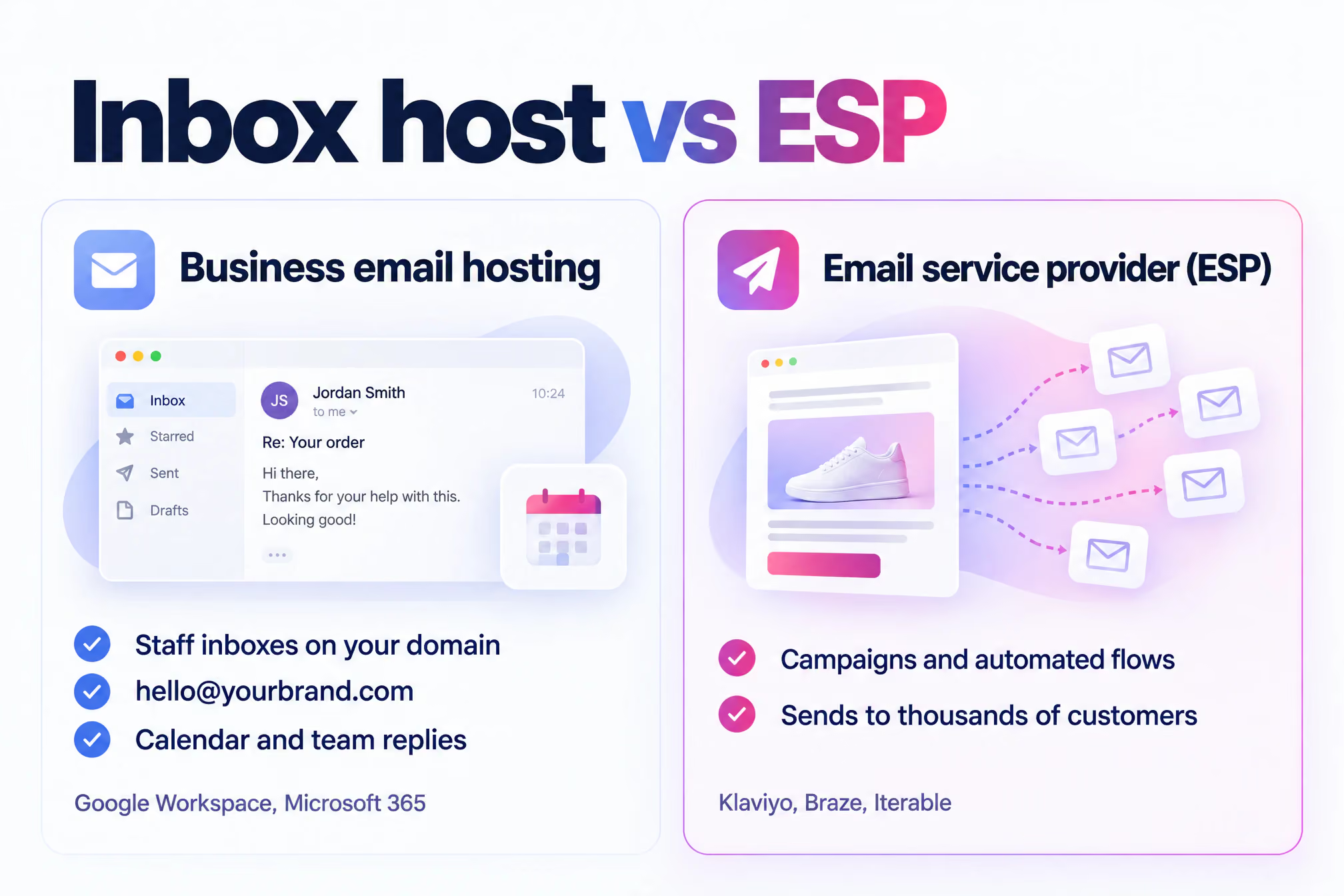
If hosting is what you came for, these names turn up in every serious review. None of them runs a lifecycle programme.
Google Workspace Bundles Gmail With Docs, Drive and Meet
Google Workspace is the default business inbox for teams that already think in Gmail. It puts Gmail on your custom domain. It adds shared calendars, Docs, Sheets, Drive storage and Meet video calls under one login. You pay per user per month, so cost scales with headcount. The collaboration tools come with the mailbox. That's the main reason to pick it.
Microsoft 365 and Exchange Online Suit Outlook Teams
Microsoft 365 is the better fit when finance and ops already live in Outlook and Excel. Its business plans run email on Exchange Online, with Teams and OneDrive alongside. Higher tiers add desktop Office apps. It matters for your ESP choice too. Microsoft runs Outlook.com, and its bulk-sender rules decide whether your campaigns land.
Zoho Mail and IONOS Keep the Cost Down
Zoho Mail is the usual answer when a small business wants a professional address for little or nothing. A free plan is available, and paid plans add storage and admin controls. IONOS takes a different route. It bundles email with domains and website hosting, which suits a founder buying everything in one place. Check the renewal rate, not just the first-year price. Hosting bundles are often discounted up front.
Proton Mail for Business Puts Encryption First
Proton Mail for Business is the pick for regulated or privacy-heavy teams. It uses end-to-end encryption. Messages between Proton users stay unreadable to anyone else, including Proton. The trade-off is a smaller collaboration suite than Google or Microsoft. For a legal, health or finance team, that's usually a fair swap.
Hostinger, Bluehost, DreamHost and Rackspace Sell Cheap Mailboxes
Budget web hosts sell mailboxes as an add-on to a website plan. Hostinger is known for low-cost mailboxes and email aliases. Bluehost and DreamHost bundle email into their hosting packages. Rackspace sells hosted email as a product in its own right, for businesses that want a specialist provider. All fine for a small team's inboxes. None of them will send a welcome flow.
Storage and Collaboration Decide What a Mailbox Really Costs
Storage limits per mailbox vary widely between plans, and the cheapest tiers fill first. Shared customer service inboxes and years of attachments eat space fastest. Compare three things. Storage per user, whether it's pooled across the team, and which collaboration tools sit in the same price. A cheap mailbox plus separate file sharing and video tools can cost more than a bundle.
How We Ranked Them, With Our Klaviyo Partnership Declared
Our ranking puts ecommerce and retention fit first, then checks every pick against two independent analyst reports and the vendors' own filings. The two reports measure different things. Gartner's Magic Quadrant for Multichannel Marketing Hubs covers multichannel platforms, not email-only tools. Forrester's Email Marketing Service Providers Wave is the email-specific ranking. A platform can lead one and be absent from the other.
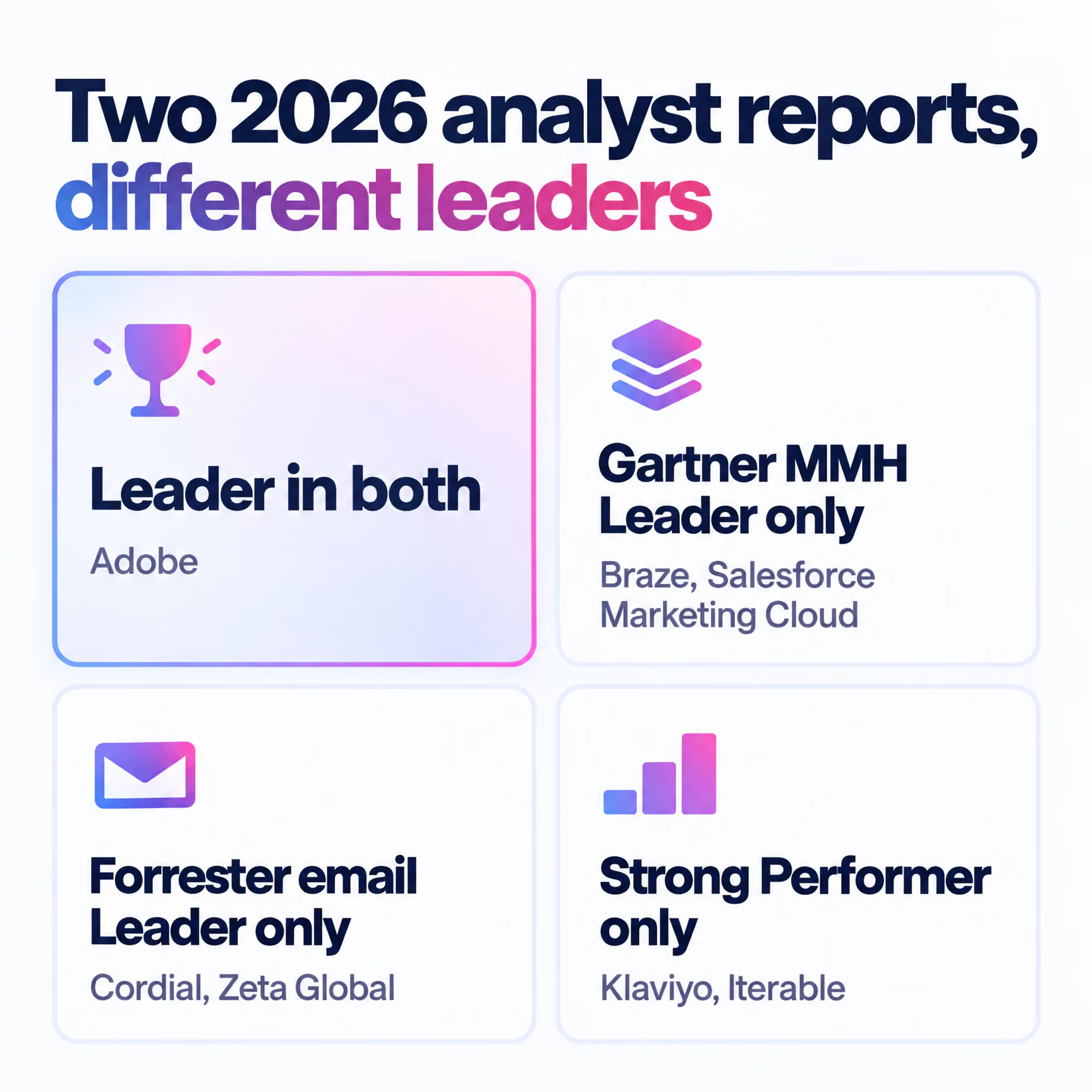
Each pick rests on these inputs.
- Placement in Gartner's 2026 Magic Quadrant for Multichannel Marketing Hubs.
- Placement in Forrester's Q1 2026 Email Marketing Service Providers Wave.
- Revenue, growth and customer numbers from earnings releases and trading updates.
- Starting prices we could confirm on vendor pages. Where we couldn't, the table says so.
- Fit with ecommerce data such as orders, products, browsing and customer profiles.
- Our own delivery work as partners of Klaviyo, HubSpot, Braze, Iterable and Shopify.
Vendor claims stay labelled as vendor claims. If a figure comes from a company's own blog or press release, we name the company.
Now the bias. We're a Klaviyo Master Platinum Partner and its 2026 Partner of the Year for UK & Ireland. We've handled that two ways. Klaviyo's position rests on pricing and data fit you can verify. And we flag where it falls short, starting with its Forrester rating. We're also a HubSpot Platinum Solutions Partner, and we still rank HubSpot as a B2B tool. Partnerships don't buy placement here.
We've ranked the top 50 email marketing platforms before. This list keeps the ten we'd put in front of an eCRM or retention team.
1. Klaviyo Is the Default for Ecommerce and DTC Brands
Klaviyo's bill tracks the people you email, not the size of your team. That's why it tops this list. It prices by active profile, starts free and reads order data well.
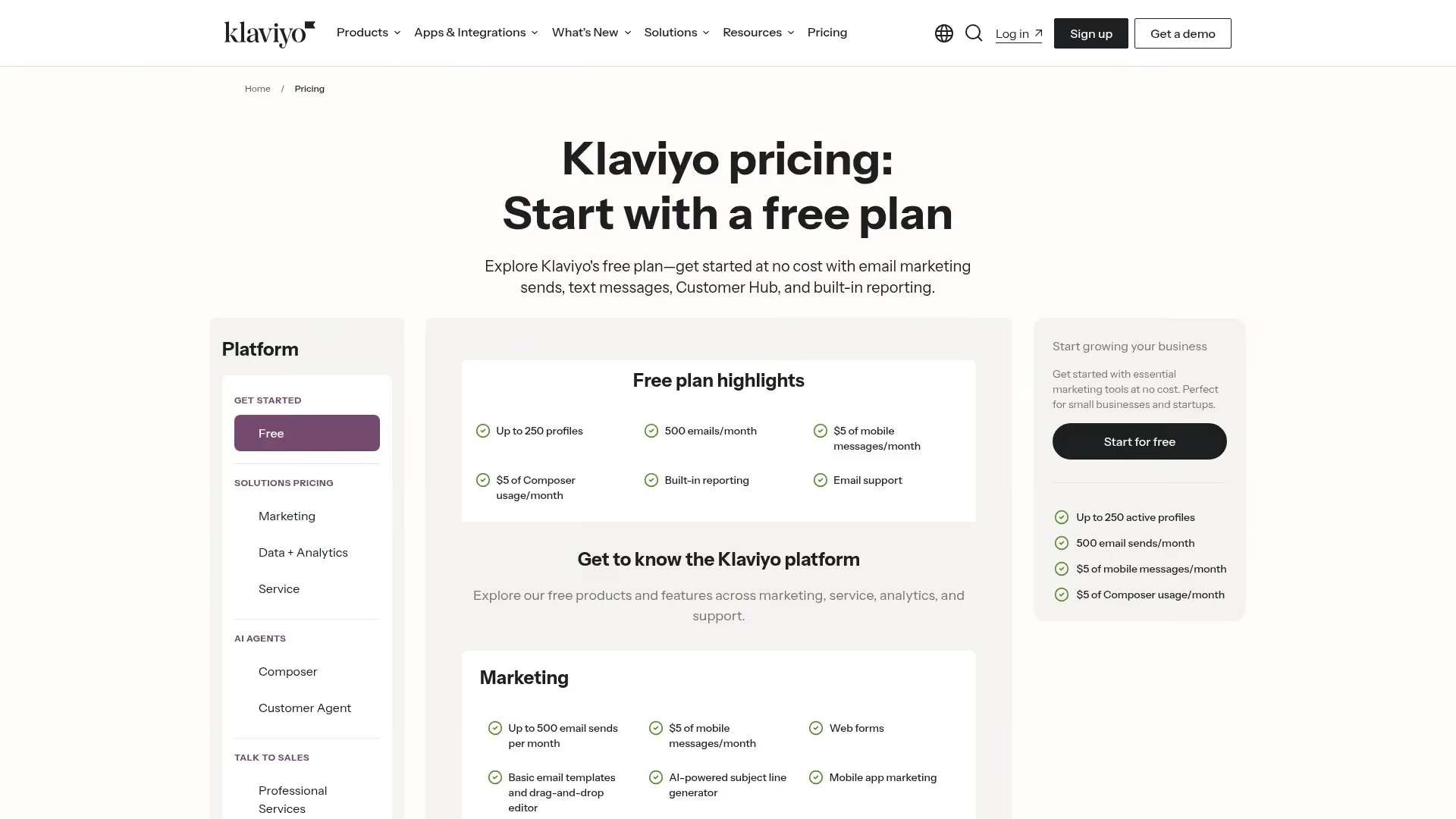
The entry point is low. Klaviyo's free plan covers up to 250 active profiles, 500 email sends a month and $5 of mobile messages a month. Its paid Email plan starts at $20 a month for 500 active profiles, per Klaviyo.
Take a new Shopify brand with 200 subscribers. It fits the free plan on profiles. But the 500-send cap bites first once a weekly campaign goes out alongside a welcome flow. At that point, or once you pass 250 active profiles, you're on paid. Plan for it from launch.
Active profiles is the line to watch as you grow. Suppress unengaged profiles before you cross a tier. Otherwise you pay to email people who never open, and your deliverability takes the hit too.
Klaviyo is also big enough to build a lifecycle programme on. It reported Q2 2026 revenue of $370.6M, up 26% year on year. Klaviyo also posted net revenue retention of 110% in Q1 2026. In plain terms, existing customers spent more than they did a year earlier. Brands stay and expand.
Now the weak spot. Forrester named Klaviyo a Strong Performer in its Q1 2026 email Wave. Not a Leader. For a Shopify brand that wants email automation and flows running off order data, the data fit matters more than the badge. For a global enterprise running a full RFP, the gap is worth weighing.
Klaviyo isn't the only option on Shopify. The native Shopify Messaging tool, formerly Shopify Email, suits campaign-only stores. Other email marketing platforms for Shopify compete for the same merchants.
2. Braze Fits App-Led Programmes With Enterprise Budgets
Braze has one of the strongest analyst records on this list. Braze says Gartner named it a Leader in the 2026 Magic Quadrant for Multichannel Marketing Hubs, its fourth year running. Forrester rated it a Strong Performer for email too.
The customer base tells you who it's built for. Braze had 2,789 customers at 31 July 2026, according to its earnings call. Of those, 361 pay at least $500K a year. Fewer, larger customers than Klaviyo or HubSpot. Raw customer counts don't compare.
Pick Braze when push, in-app messages, email and SMS need to run off one real-time profile. You'll also need engineering support to stream events into it. Do that properly and Braze handles personalisation at app scale. For a small Shopify store, it's far too much platform.
3. Salesforce Marketing Cloud Pays Off Only on a Salesforce Stack
Salesforce Marketing Cloud earns its place when your customer record already lives in Salesforce. Gartner named SFMC a Leader in its 2026 Magic Quadrant for Multichannel Marketing Hubs. A Leader rating says the platform can do a lot. It says nothing about how long your team will take to build it.
If Sales Cloud and Service Cloud hold the customer record, SFMC keeps marketing on that same record. That's the full CXM case, and it's a strong one. Without the wider stack, you'd be buying an enterprise integration project just to send email.
Plan for specialist admins and a longer build than any self-serve tool. We couldn't verify a current list price, so budget for a sales-led quote.
4. Bloomreach Joins Commerce Search, Data and Email
Bloomreach suits commerce teams that want product search, customer data and email on one platform. It was recognised in Gartner's 2026 Magic Quadrant for Multichannel Marketing Hubs. Bloomreach also says it was among the three highest-scoring vendors in every use case in Gartner's 2026 Critical Capabilities report. That's the company's reading of the report. Ask which use cases match your programme and check the scores for those.
The draw is commerce data. Bloomreach pairs marketing automation with product discovery and merchandising. So catalogue data and browsing behaviour can feed personalisation without a separate tool in between. It's a heavier buy than Klaviyo. It makes most sense for retailers with large catalogues and their own data team.
5. Iterable Is the Cross-Channel Pick Without the Enterprise Suite
Iterable gives growth-stage brands flexible cross-channel orchestration without the weight of an enterprise suite. Forrester named Iterable a Strong Performer in its Q1 2026 email Wave, alongside Klaviyo and Braze.
Investors have backed it heavily. Iterable raised a $200M Series E at a $2B valuation in June 2021.
Pick Iterable when email, SMS, push and in-app need to sit in one journey builder. Your team should be comfortable working with event data. As an Iterable partner, we'd place it between Klaviyo's ecommerce focus and Braze's enterprise scale. It suits subscription and app-plus-web brands that have outgrown a pure email tool.
6. Dotdigital Is the Mid-Market Multichannel Pick for UK Retail
Dotdigital's recurring revenue is growing faster than its headline number. Contracted ARR on its core platform reached £85.4M at 30 June 2026, up 18%. Only 8% of that growth was organic.
Total revenue moved slower. The UK-listed company reported FY26 revenue of £90.9M, up 8%, in an unaudited trading update for the year to 30 June 2026. Audited results follow on 3 November 2026.
Shortlist it if you're a UK or European mid-market business whose customer record sits in a CRM and whose programme runs across several channels. Klaviyo still wins on a Shopify-led DTC store.
7. HubSpot Marketing Hub Is Built for B2B Pipelines, Not Retail
HubSpot's data model is built around contacts, companies and deals moving through a sales pipeline. That's ideal for lead nurture and sales handover. Ecommerce retention runs on orders, products and repeat purchase. Klaviyo reads those natively. HubSpot makes you work for them. So it's the best pick here for B2B and the weakest for retail. That's our view, and we hold it as a HubSpot Platinum Solutions Partner.
Scale isn't the issue. HubSpot reported 306,446 customers at 30 June 2026, up 14%. That count covers every HubSpot hub, not just Marketing Hub.
Entry pricing is cheap. HubSpot's own pricing guide lists Starter at $9 per seat a month billed annually, or $10 monthly. The same guide puts Professional at $800 a month with three seats included. HubSpot's Starter product page currently shows a $20 list price per seat. It also shows limited-time offers of $7 annual or $10 monthly.
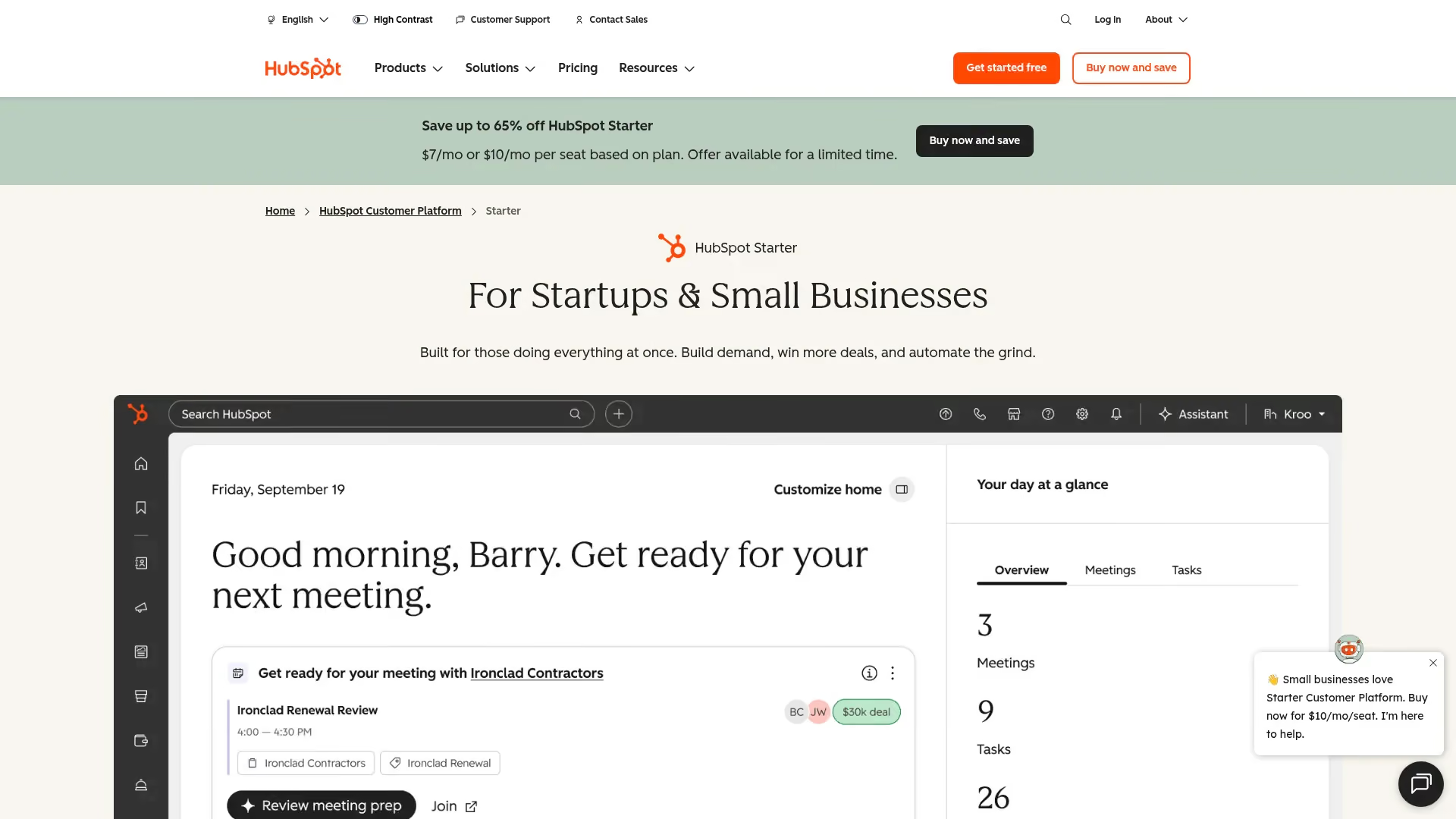
Annual billing is cheaper per seat but locks you in for the year. Check the renewal price before a limited-time offer ends. And check which tier holds the features you need. The jump from Starter to Professional is steep.
8 to 10. Adobe, Cordial and Zeta Global Led Forrester's Email Wave
Adobe, Cordial and Zeta Global were the Leaders in Forrester's Q1 2026 Email Marketing Service Providers Wave. That's why they close out the ten. Each belongs on an enterprise shortlist, for different reasons.
Adobe
Adobe is the only platform in this ten that leads both reports. Forrester rated it a Leader for email, and Gartner named Adobe a Leader in its 2026 Magic Quadrant for Multichannel Marketing Hubs. That makes it the most analyst-proof pick for a large enterprise already running Adobe's content and analytics tools. For a mid-size DTC brand, it's a lot of platform.
Cordial
Cordial is the least familiar name in this ten, yet Forrester ranked it a Leader above Klaviyo, Braze and Iterable. If email is your main revenue channel and you're running an enterprise RFP, put it in the room. We couldn't verify its pricing, so treat it as a shortlist prompt and judge it on a demo with your own data.
Zeta Global
Zeta Global completes Forrester's trio of email Leaders. Shortlist it next to Adobe and Cordial if you want three email-first enterprise vendors bidding against each other. Make each one demo against your volumes and your data feeds. Then compare how fast a profile updates and who builds the first flows, not just the headline quote.
Deliverability Starts With SPF, DKIM and DMARC on Your Domain
Every ESP on this list sends from your domain, so inbox placement starts with three DNS records you control. SPF, DKIM and DMARC. Together they verify that a message really comes from you.
Mailbox providers now enforce them. Microsoft announced new Outlook rules on 2 April 2025. Outlook now requires SPF, DKIM and DMARC from domains sending more than 5,000 emails a day to Outlook.com, Hotmail and Live.com addresses. Enforcement began on 5 May 2025. If your list is big enough to need an ESP, assume the rule applies to you.
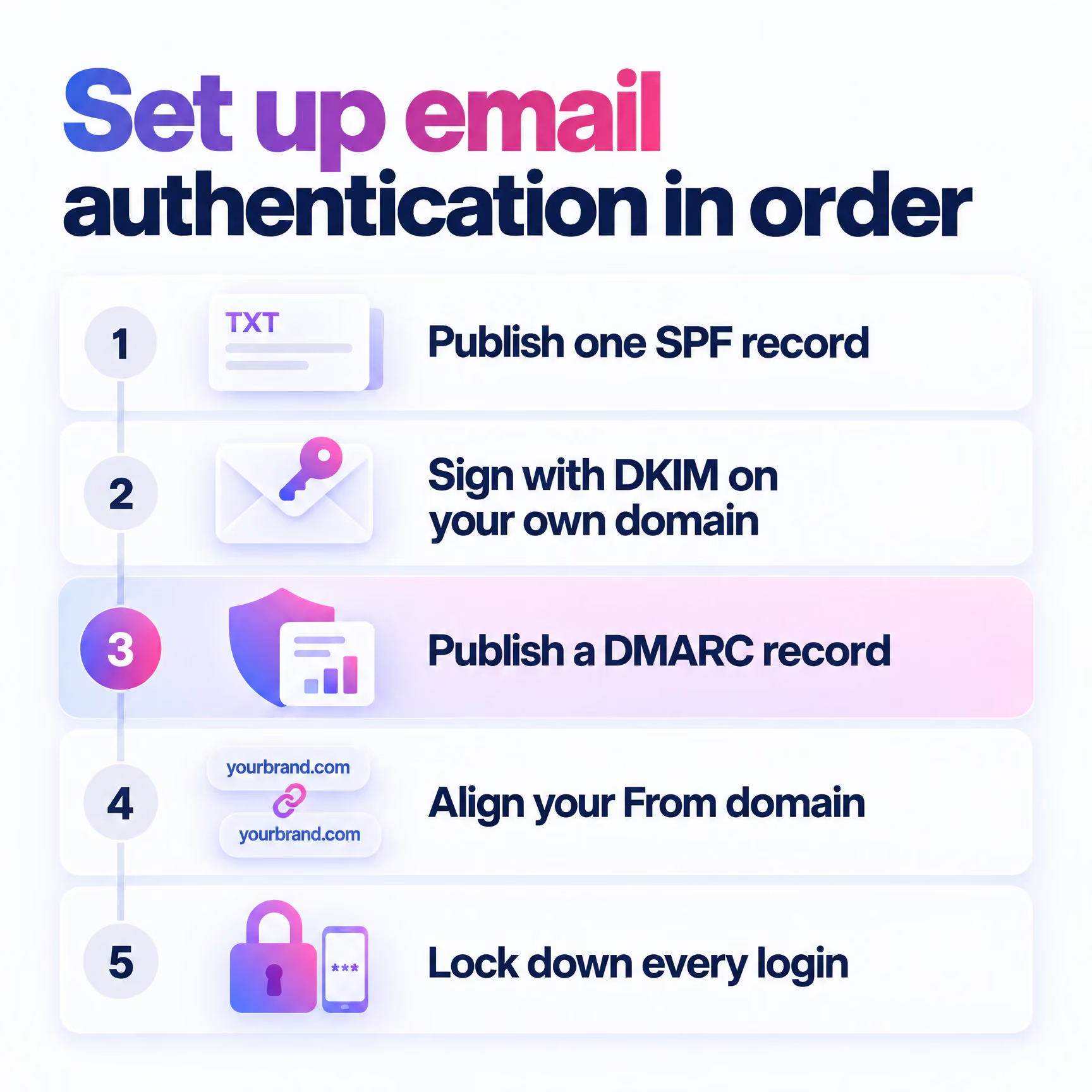
Work through these steps once, in order, whichever platform you choose.
- Publish one SPF record. Include both your ESP and your inbox host. Two separate SPF records break authentication.
- Sign with DKIM on your own domain. Set it up in the ESP rather than sending on the platform's shared domain.
- Publish a DMARC record. Start at
p=noneto collect reports, then tighten to quarantine and reject. - Align your From domain. It must match the SPF or DKIM domain, or DMARC fails anyway.
- Lock down every login. Turn on two-step verification for each staff inbox and each ESP user.
Your inbox host plays its part here too. Google Workspace and Microsoft 365 handle spam filtering, encryption in transit and two-step verification for staff mailboxes. Your ESP account needs the same login hygiene. A hijacked ESP login can email your whole list.
Authentication gets you to the inbox door. Staying in the inbox is the ongoing work of email marketing deliverability, from list hygiene to engagement-based sending. Do it properly or your platform choice won't matter.
Five Questions That Cut the Shortlist to Two
Five questions narrow a ten-platform list to two faster than any feature grid. Answer them before you book a single demo.
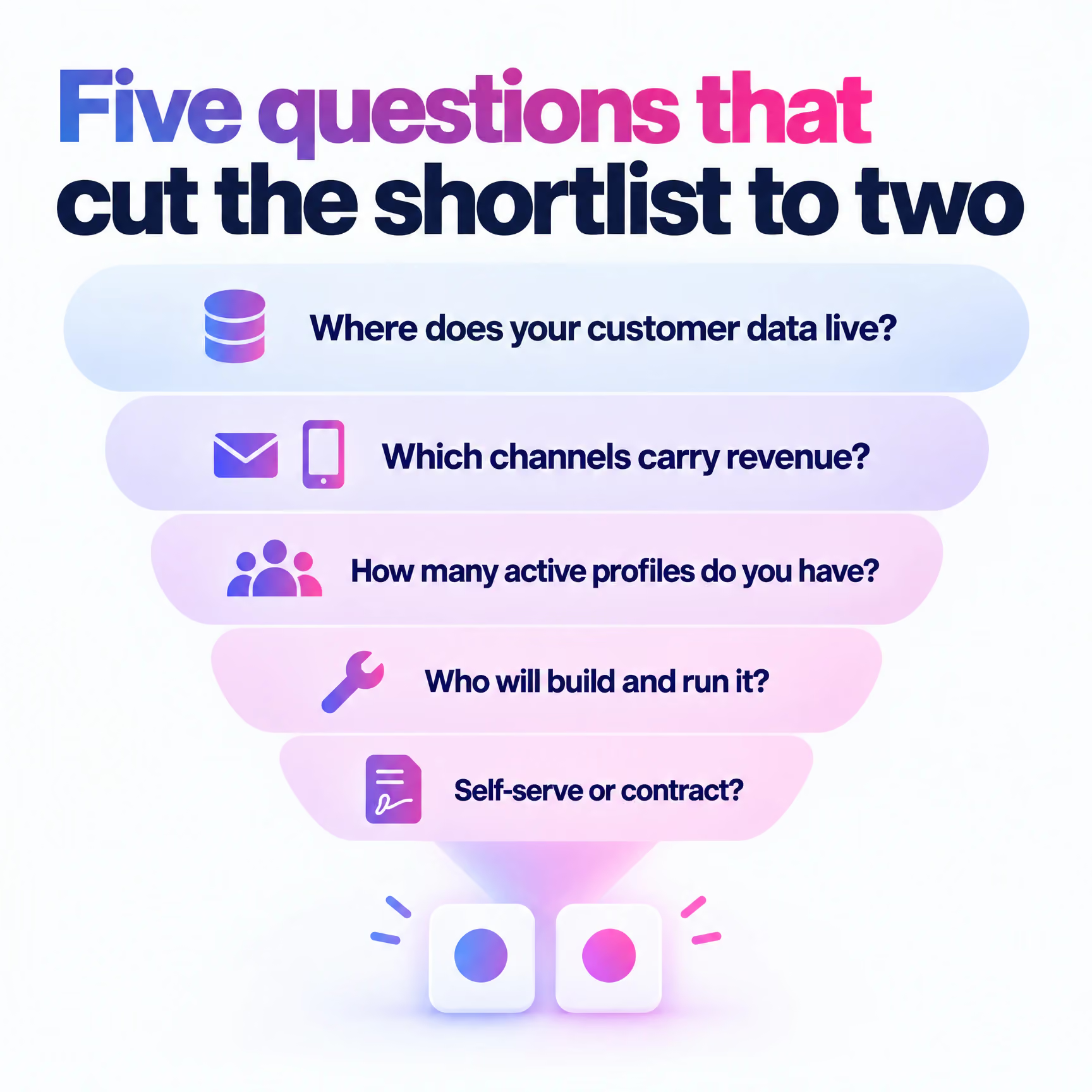
- Where does your customer data live? Shopify points to Klaviyo. Salesforce points to SFMC. Microsoft Dynamics points to Dotdigital. A HubSpot CRM with a B2B pipeline points to HubSpot.
- Which channels carry revenue? Email and SMS favour Klaviyo. App push and in-app messages favour Braze or Iterable.
- How many active profiles do you have? Profile-based pricing rewards a clean list. Run your count against Klaviyo's tiers before comparing anything else.
- Who will build and run it? A small in-house team needs a self-serve tool. SFMC, Adobe and Braze need specialist skills or a partner.
- Self-serve or contract? Klaviyo and HubSpot publish entry prices. For the rest, expect a sales conversation and negotiate on your own volumes.
The Best ESP for Each Type of Business
Most businesses fit one row of this table, and that row is your shortlist.
Quick Answers on Email Service Providers
Is an ESP the Same as Business Email Hosting?
No. Business email hosting, such as Google Workspace or Microsoft 365, gives your staff inboxes on your domain. An ESP sends to customers from that domain.
What Does an Email Service Provider Do?
It sends marketing campaigns and automated flows to your customers. Klaviyo, Braze and Iterable are ESPs.
Which ESP Is Cheapest to Start?
Klaviyo, because its free plan covers up to 250 active profiles. HubSpot Starter is cheap per seat but suits B2B teams, not retail.
Which ESP Is Best for Shopify?
Klaviyo, for Shopify brands that run flows and personalisation. Shopify Messaging is enough for stores that only send campaigns.
Is There a Free Business Email Option?
For staff inboxes, Zoho Mail offers a free plan. For marketing email, Klaviyo's free plan is the strongest starting point for ecommerce.
Price Your List Before You Book a Single Demo
Pull your active profile count today. Run it against Klaviyo's free tier and $20 entry plan, then against HubSpot's per-seat Starter price in the table. Next, take your answer to the data-source question. Shortlist the two platforms that match it. Demo those two only.
Want a second pair of eyes on the shortlist before you sign? Enchant's email marketing audit covers it.