Dotdigital vs Klaviyo: When Each Platform Actually Wins

Choose Klaviyo if you're a Shopify-led DTC brand that wants deep ecommerce flows and transparent per-profile pricing, and choose Dotdigital if you run a mid-market, multi-channel or B2B programme tied to Microsoft Dynamics, Salesforce or Adobe Commerce. That's the Dotdigital vs Klaviyo call in one line. Klaviyo reports that 77.9% of its ARR came from customers who also use Shopify at the end of 2025. Dotdigital's recent wins include the Royal Air Force, Save the Children and Serco. Two platforms. Two different centres of gravity.
Full disclosure. Klaviyo named Enchant its 2026 EMEA UK & Ireland Partner of the Year, and we're a Klaviyo Master Platinum Partner. So here's exactly where we'd still point a client to Dotdigital.
The Dotdigital vs Klaviyo Verdict Hinges on Your Customer Record
The system that owns your customer record decides this choice, far more than any feature list. Find that system and the answer usually follows.
- Shopify owns the record. You're DTC, email and SMS carry retention, and order history is your richest data. Pick Klaviyo.
- A CRM or Adobe Commerce owns the record. Dynamics 365 or Salesforce holds the account, or you sell B2B, into the public sector, to donors or to students. Pick Dotdigital.
- The record is split. Shopify takes the orders but a CRM holds the relationship. Pick the platform that connects natively to whichever system your team treats as the source of truth.
Klaviyo Is a B2C CRM, Dotdigital Is a Cross-Channel Data Platform
Klaviyo and Dotdigital both send email and SMS, but they're built for different organisations with different data.
Klaviyo Sells Itself as the Autonomous B2C CRM
Klaviyo now describes itself as "the autonomous B2C CRM". The B2C part matters most. Yes, it sends email. Email and SMS are its core channels, run from customer profiles fed by your store data.
Klaviyo reported more than 205,000 customers at 30 June 2026. Its customers generating over $50K of ARR rose 36% year on year to 4,477. So it's moving upmarket. The base is still small business, though. On G2, about 81% of Klaviyo reviews come from small businesses.
Dotdigital Is a CXDP With a Broader Client List
Dotdigital calls its core product a CXDP, a customer experience and data platform. In plain terms, it's a cross-channel CXM tool that plugs into the CRM and commerce systems larger organisations already run. Its clients stretch well past retail, from Loughborough University to PKF Littlejohn, FujiFilm and Helly Hansen. G2 data shows about 46% of Dotdigital reviews come from mid-market companies.
Size is the other gap. Klaviyo booked $370.6M of revenue in Q2 2026 alone. Dotdigital's revenue for the whole year to 30 June 2026 was £90.9m, up 8%. One quarter against a full year, in different currencies. The gap is still obvious. Dotdigital competes on fit, not scale.
Side by Side, Klaviyo Wins on Shopify and Dotdigital on CRM Fit
Klaviyo leads on Shopify depth, ease of use and pricing transparency, while Dotdigital leads on native CRM integration and channel breadth. The table below compares both on the criteria that decide most evaluations. Review scores are at time of writing.
Integrations Decide This Choice More Than Any Feature
A platform can only personalise on data it can reach. Pick the one that sits closest to your customer record.
Klaviyo's advantage is Shopify depth. Shopify brands have plenty of email platforms built for Shopify to pick from. Klaviyo is the one Shopify recommends to Plus merchants globally under their partnership. It also lists more than 350 integrations.
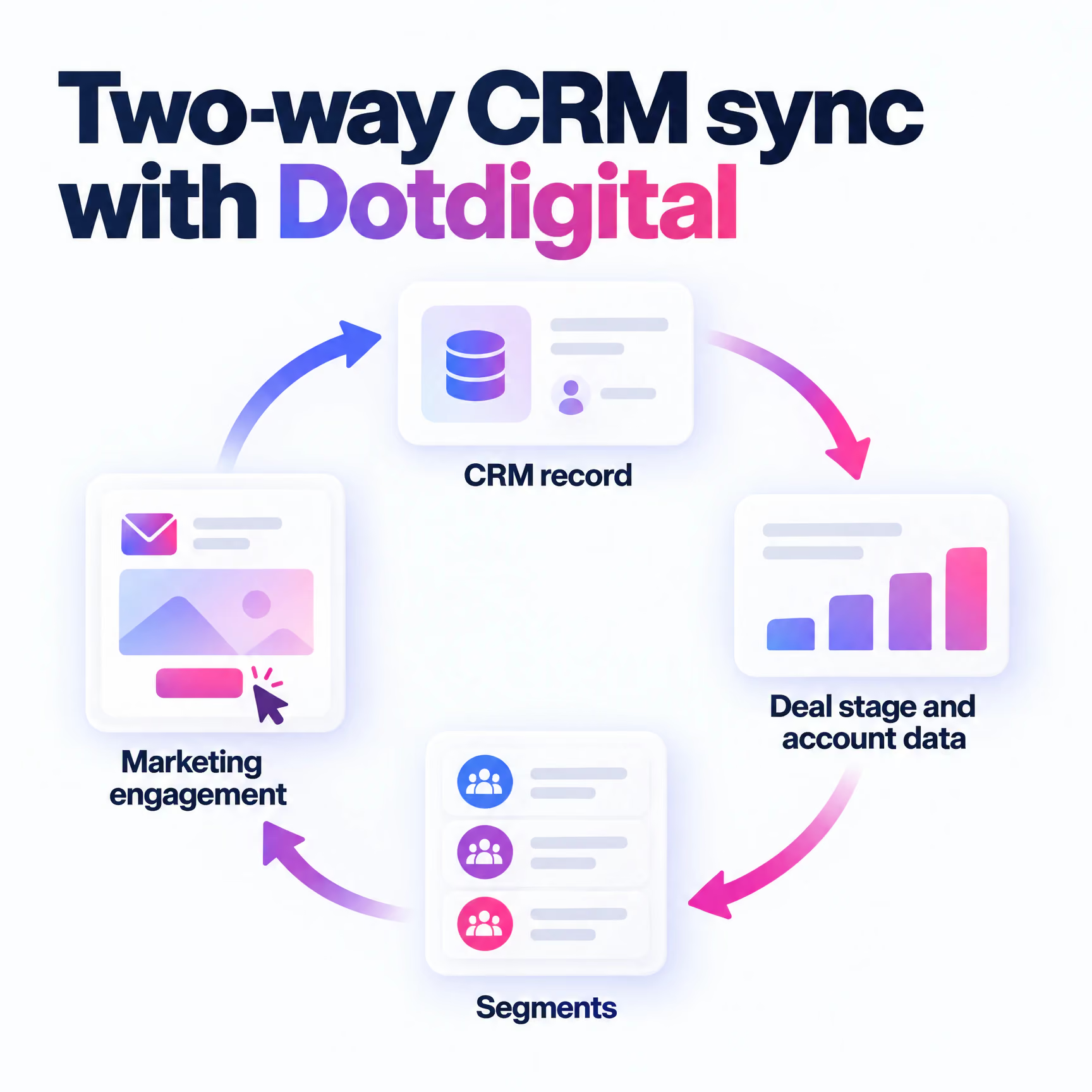
Dotdigital's advantage is the CRM and enterprise commerce layer. Its native integrations, per Dotdigital's documentation, cover Microsoft Dynamics 365 with two-way field sync, Salesforce CRM, Magento/Adobe Commerce, Salesforce Commerce Cloud, BigCommerce, Shopware, WooCommerce and Shopify. It also documents a connector for Adobe Commerce as a Cloud Service, Adobe's newer cloud edition. Moving to that edition? Confirm the connector version in your demo.
Sales-led teams should weigh the two-way sync. Marketing engagement writes back to the CRM record your sales team works from. Deal stage and account data flow into your segments. In B2B, that matters far more than in DTC. Every middleware hop is one more sync to monitor.
Both Run the Core Ecommerce Flows, Klaviyo Launches Them Faster on Shopify
Both platforms cover the standard ecommerce email automation and flows, so the difference is where each flow's trigger data comes from. The core set looks like this on either tool.
- Welcome. Triggered by a signup form or new account.
- Abandoned cart and browse abandonment. Triggered by checkout and on-site product events.
- Post-purchase. Triggered by an order being placed or fulfilled.
- Win-back. Triggered by time since last order.
- Back in stock. Triggered by an inventory change.
On Klaviyo, a Shopify brand gets checkout, order and product data into profiles once the integration is live. An abandoned cart flow showing the exact products left behind is a quick build. No developer. No custom events.
Dotdigital runs the same flows, but its journeys earn their keep when the trigger lives outside the store. A renewal date in Dynamics. A lead status change in Salesforce. A course enquiry at a university. Those fire journeys directly from the CRM, which is where a B2B or education lifecycle programme starts.
Klaviyo Reads Order Data Best, Dotdigital Adds Zero-Party Data
The real split is inferred versus declared data. Klaviyo predicts what customers want from their order history. Dotdigital can also ask them. Klaviyo's predictive analytics come built in, covering predicted customer lifetime value, churn risk and product recommendations. That's how a VIP and a one-off buyer end up in different segments without a spreadsheet.
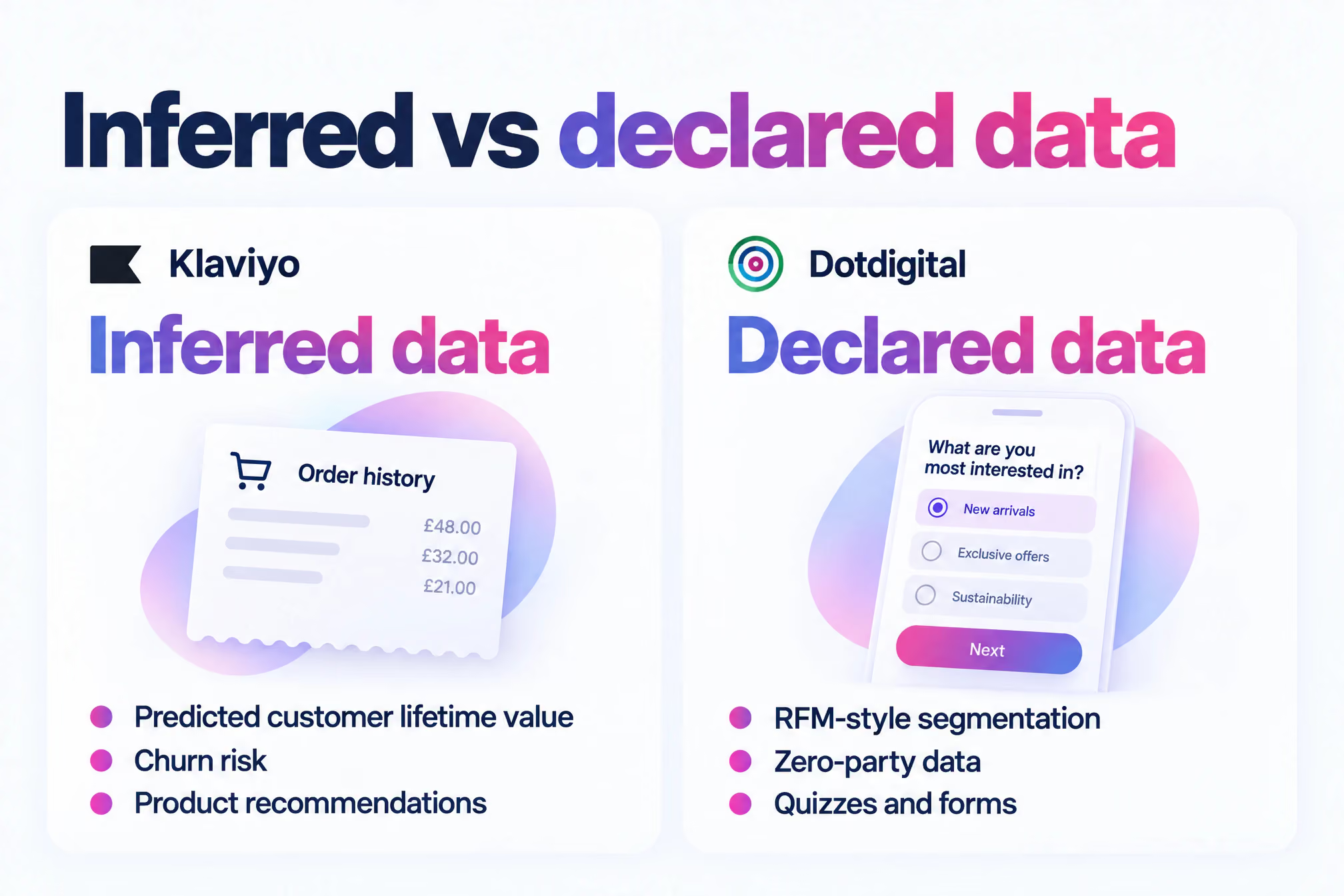
Dotdigital offers RFM-style segmentation, grouping customers by recency, frequency and monetary value. It also has zero-party data, the preferences customers tell you directly through quizzes and forms. That arrived with Alia. Dotdigital completed the Alia deal in March 2026, when Alia had about 2,700 customers and ARR above $8m.
Dotdigital's own research makes the case for asking. In a Censuswide survey of 4,000 consumers across the UK, US, Australia and Singapore, commissioned by Dotdigital, only 15% said brand marketing feels relevant. Vendor-funded, yes. It's still the problem both platforms are selling against.
Dotdigital Has Pushed Further Into WhatsApp and Loyalty
If you want WhatsApp and loyalty run from the same platform as email, Dotdigital is the stronger shortlist candidate. It fully launched WhatsApp in April 2025, and just over 30 customers were using it by its FY25 results. Early days. Ask for a reference in your sector.
Loyalty followed. Dotdigital launched Dotdigital Loyalty on 16 July 2026, initially for Shopify merchants. Want to avoid a separate loyalty tool? Book a demo.
Klaviyo's channel strength is email and SMS running off the same profile. It sells both together in one Email + SMS plan. For a DTC retention programme, that pairing does most of the work. For push, RCS or web personalisation, ask each vendor to demo the exact channel live, in an account like yours.
Both Platforms Are Betting on AI Agents, in Different Ways
Dotdigital's AI approach is about access, while Klaviyo's is about automation running on its own data. Dotdigital launched Agents in Dotdigital in July 2026, a natural-language interface for working in the platform. It also launched an MCP server that connects Dotdigital to the LLM your team already uses.
The time saved is concrete. You describe a segment instead of stacking rules. Analysts query campaign data from their own AI tool instead of exporting CSVs.
Klaviyo's "autonomous B2C CRM" positioning points the other way. Predictive fields and automation run inside Klaviyo, on Klaviyo's profile data. Less setup if your data already lives there. Less flexibility if it doesn't.
Neither replaces strategy. An agent builds the segment you ask for. It won't tell you which segment matters.
Klaviyo Publishes Its Prices, Dotdigital Quotes Them
At 10,000 profiles, Klaviyo's Email plan costs about $150 a month, straight off a public price list. Dotdigital's Shopify plans start at $187 a month. Beyond that app listing, you need a quote. Klaviyo has billed on active profiles since early 2025, according to Carly. The figures below come from three third-party reviewers: Emailtooltester, Omnisend (a Klaviyo competitor) and Kanal. The Dotdigital price comes from its own Shopify App Store listing.
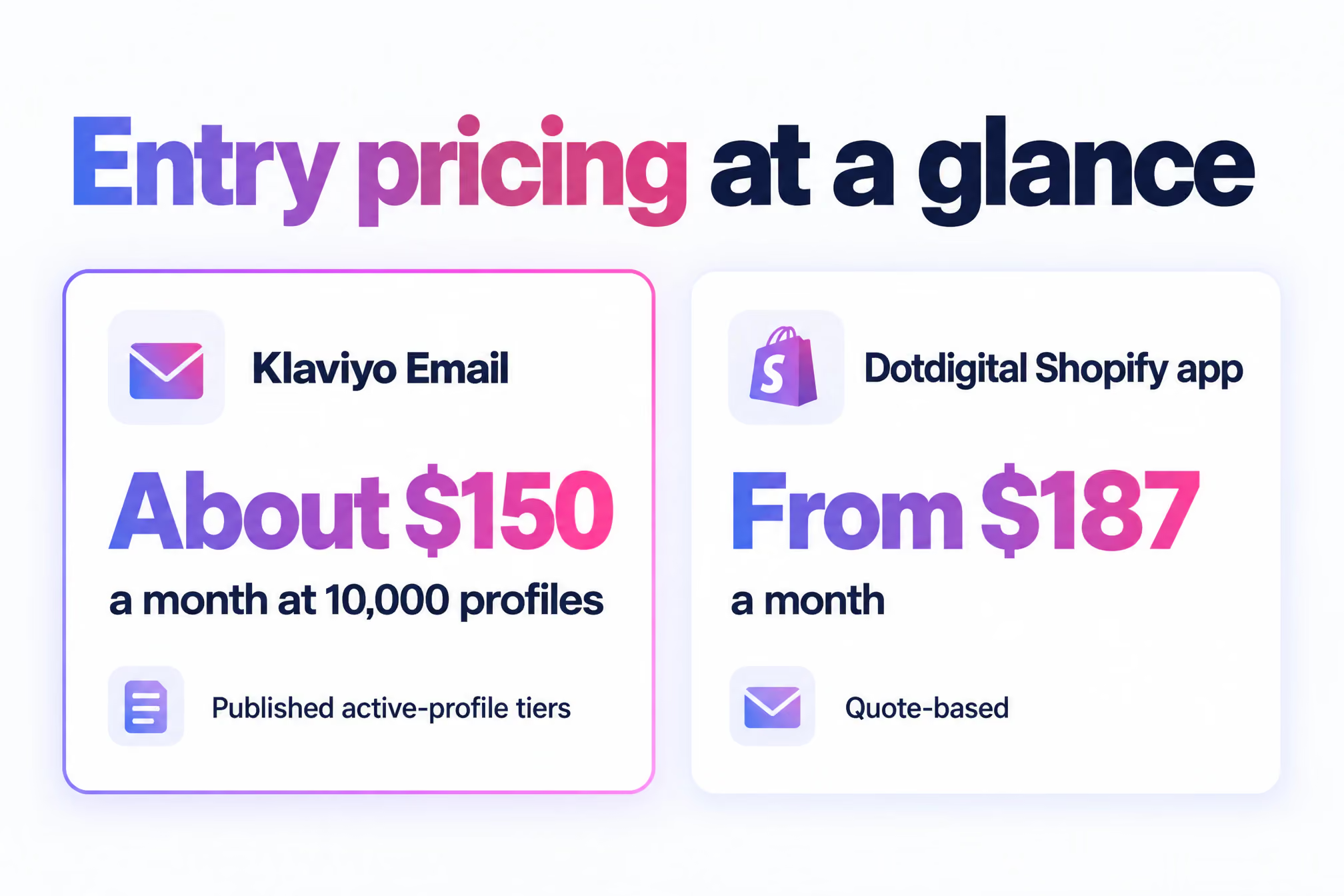
Emailtooltester also notes Klaviyo's free plan includes 150 SMS/MMS credits. Dotdigital's Shopify listing offers a 14-day free trial and flags regional price variances.
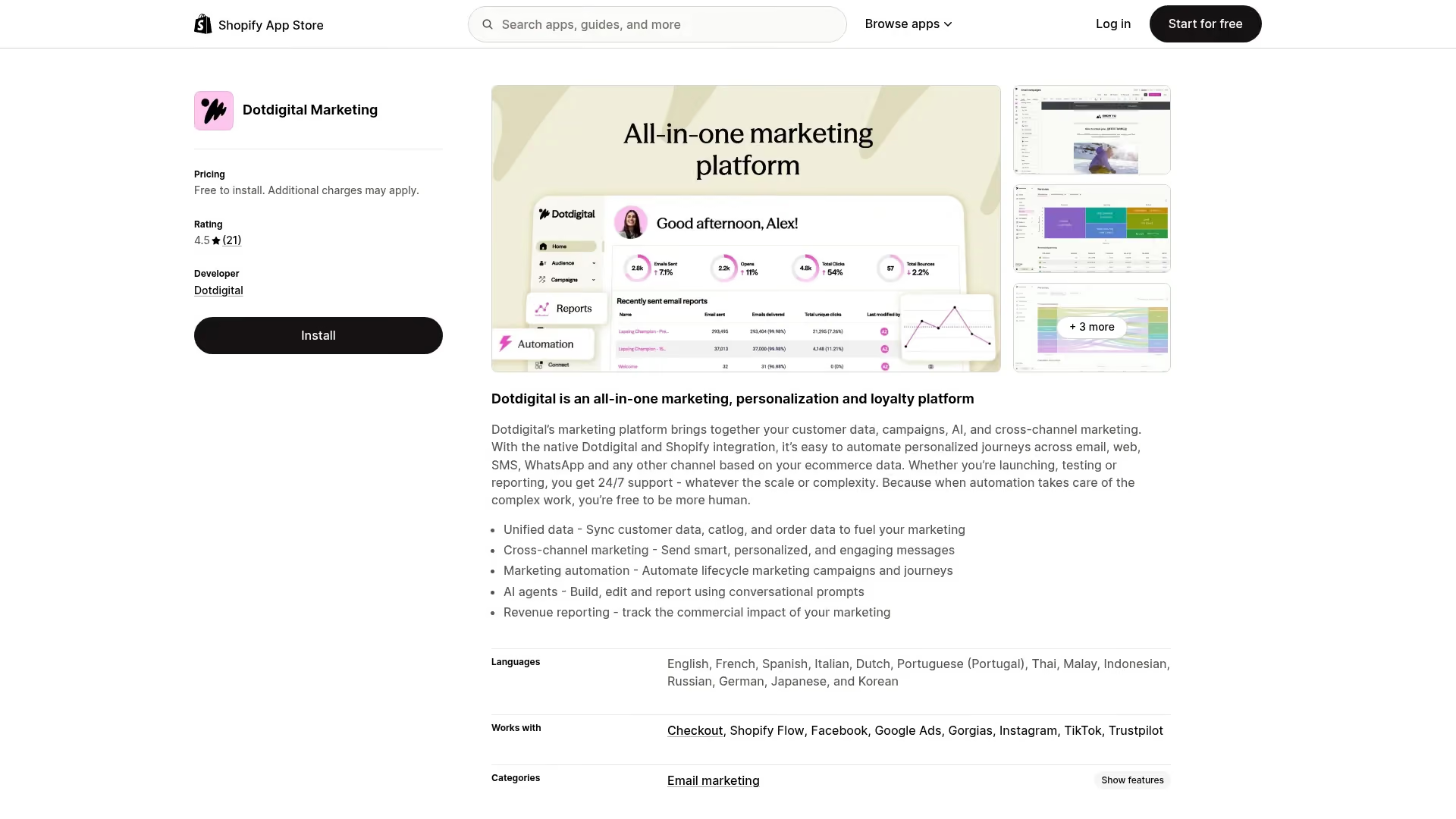
The listing doesn't tie the $187 to a contact count. App pricing may also differ from direct or enterprise deals. Get a written Dotdigital quote at your real volume before you compare. And clean your Klaviyo list before pricing it. Paying for profiles that never open is a choice.
Klaviyo Is Easier to Run, Dotdigital Scores Higher on Support
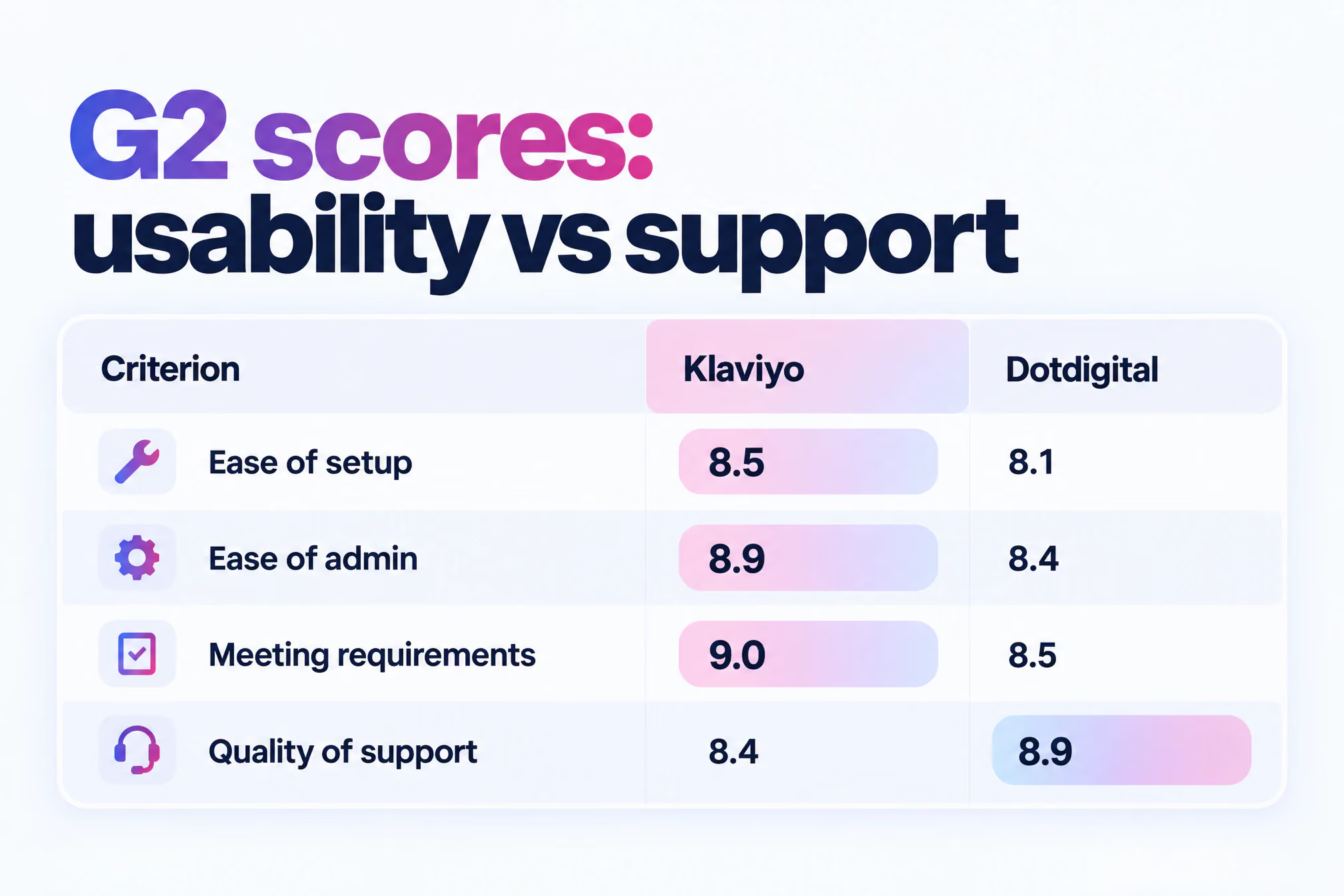
Review data splits neatly, with Klaviyo ahead on day-to-day usability and Dotdigital ahead on support.
Klaviyo Is Quicker to Set Up and Administer
Klaviyo wins every usability measure in the review data. G2's sub-scores put Klaviyo ahead on ease of setup (8.5 vs 8.1), ease of admin (8.9 vs 8.4) and meeting requirements (9.0 vs 8.5). Capterra users rate Klaviyo's ease of use at 4.5 against 4.2. A lean DTC team without a dedicated CRM manager will feel that gap.
Dotdigital Leads on Support, by G2's Measure
Dotdigital's clearest review-site win is support. G2 users score its quality of support at 8.9 against Klaviyo's 8.4. Capterra is less decisive, with both on 4.3 for customer support. If your team needs hand-holding through complex CRM integrations, ask both vendors exactly who you'd speak to at your contract size.
Deliverability Comes Down to Setup, Not the Logo
Deliverability on either platform depends on your authentication and sending habits more than the tool. Configure SPF, DKIM and DMARC on your sending domain before the first send. Only take a dedicated IP if your volume can keep it warm. Then watch engagement, because mailbox providers do. A platform switch won't fix a list that ignores you.
Four Stacks, Four Picks
Four common stacks make the trade-offs concrete, and each gets a clear pick.
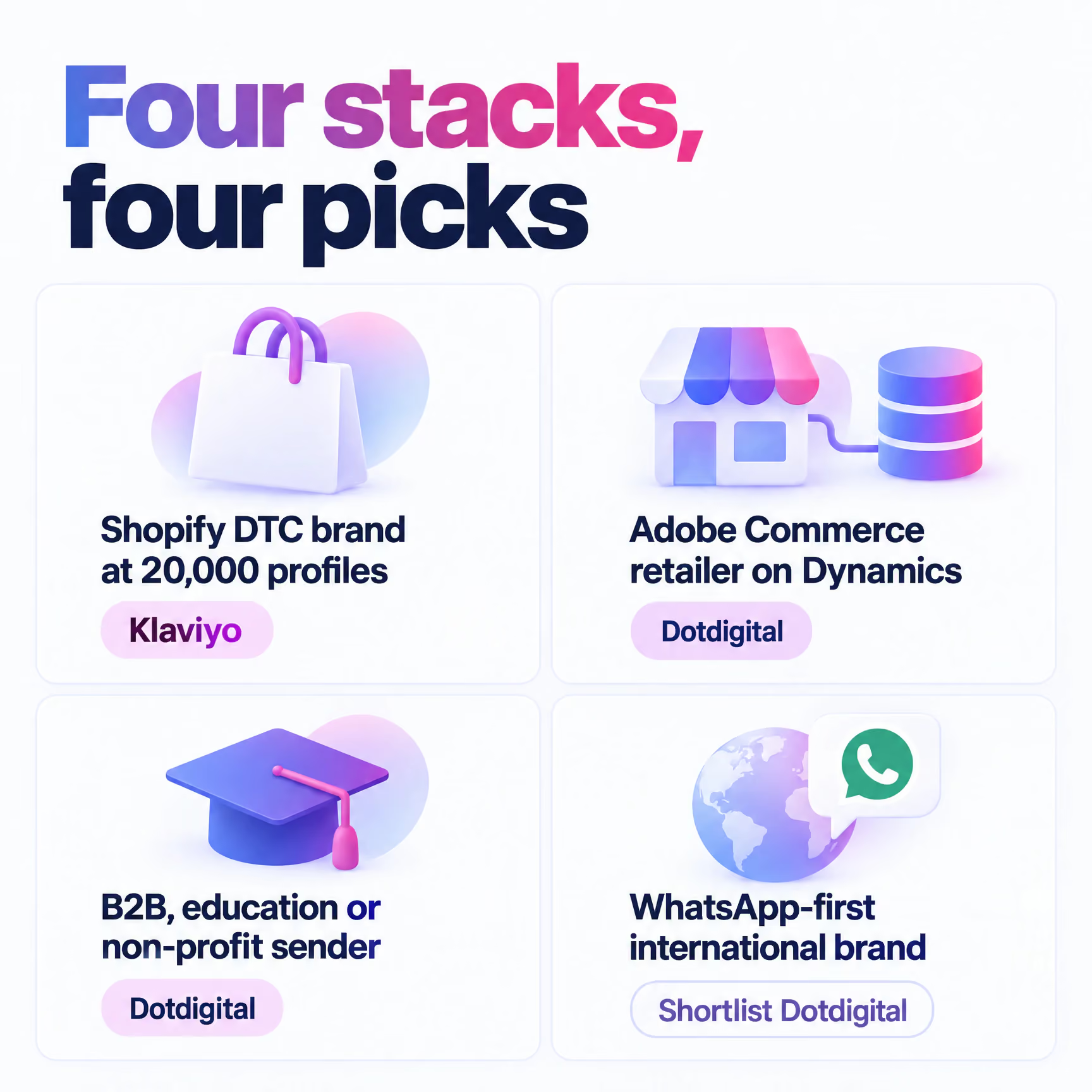
A Shopify DTC Brand at 20,000 Profiles Picks Klaviyo
Klaviyo is the pick for a Shopify DTC brand at this size. Order data feeds predictive segments from day one, flows launch quickly, and published tiers let you model cost as you grow. Price the plan at the profile count you expect in 18 months, not today. Ambitious brands outgrow their first tier fast.
An Adobe Commerce Retailer on Dynamics Picks Dotdigital
Dotdigital is the pick when Adobe Commerce runs the store and Dynamics 365 holds the customer. Two-way field sync keeps sales and marketing on one record. If you're moving to Adobe Commerce as a Cloud Service, confirm the connector version in your demo, since Dotdigital documents support for that edition.
A B2B, Education or Non-Profit Sender Picks Dotdigital
Dotdigital is the pick for organisations that don't sell through a basket. Its client list runs from Save the Children to Loughborough University, and its reviewers skew mid-market. Klaviyo's own positioning says B2C. Take it at its word.
A WhatsApp-First International Brand Shortlists Dotdigital
Dotdigital goes on the shortlist when WhatsApp is a primary channel, because it ships WhatsApp alongside email and SMS. Adoption is still early, so run a pilot in one market before migrating everything. If Shopify still owns your customer record, test Klaviyo in the same pilot. The record question outranks the channel question.
Quick Answers
What's Better Than Klaviyo?
For a Shopify-led DTC brand, very little on ecommerce depth. If your customer record lives in Dynamics, Salesforce or Adobe Commerce, or you sell B2B, Dotdigital is often the better fit.
What Is the Dotdigital Platform?
Dotdigital is a customer experience and data platform (CXDP) covering email, SMS, WhatsApp, loyalty and automated journeys. It integrates natively with CRMs such as Dynamics 365 and Salesforce and commerce platforms such as Adobe Commerce and Shopify.
Does Klaviyo Send Emails?
Yes. Email is Klaviyo's core channel alongside SMS, and both run from the same customer profiles and flows.
What Are Some Popular Digital Marketing Platforms?
For eCRM and lifecycle marketing, popular choices include Klaviyo, Dotdigital, HubSpot, Braze and Iterable. The wider list of email marketing platforms worth comparing runs much longer.
Name the System That Owns Your Customer Record
Open your stack diagram today and name the system that owns the customer record. If it's Shopify, pick Klaviyo. If it's a CRM or Adobe Commerce, shortlist Dotdigital.
Not sure which system that is? Our multi-channel CRM strategy and consulting team can help you work it out, even when the answer isn't Klaviyo.