.svg)
Shopify Email vs Klaviyo: When Each One Actually Wins
.avif)
The Shopify Email vs Klaviyo decision sometimes depends on the store stage, but generally the right solution is to move to Klaviyo as soon as possible and build everything out there. Shopify Email, now called Shopify Messaging, suits simple needs and gives stores on Basic, Grow, Advanced and Plus plans 10,000 free emails a month, then $1 USD per 1,000. Klaviyo suits brands that need behavioural segmentation and branching flows, and its free plan covers 250 active profiles and 500 sends a month.
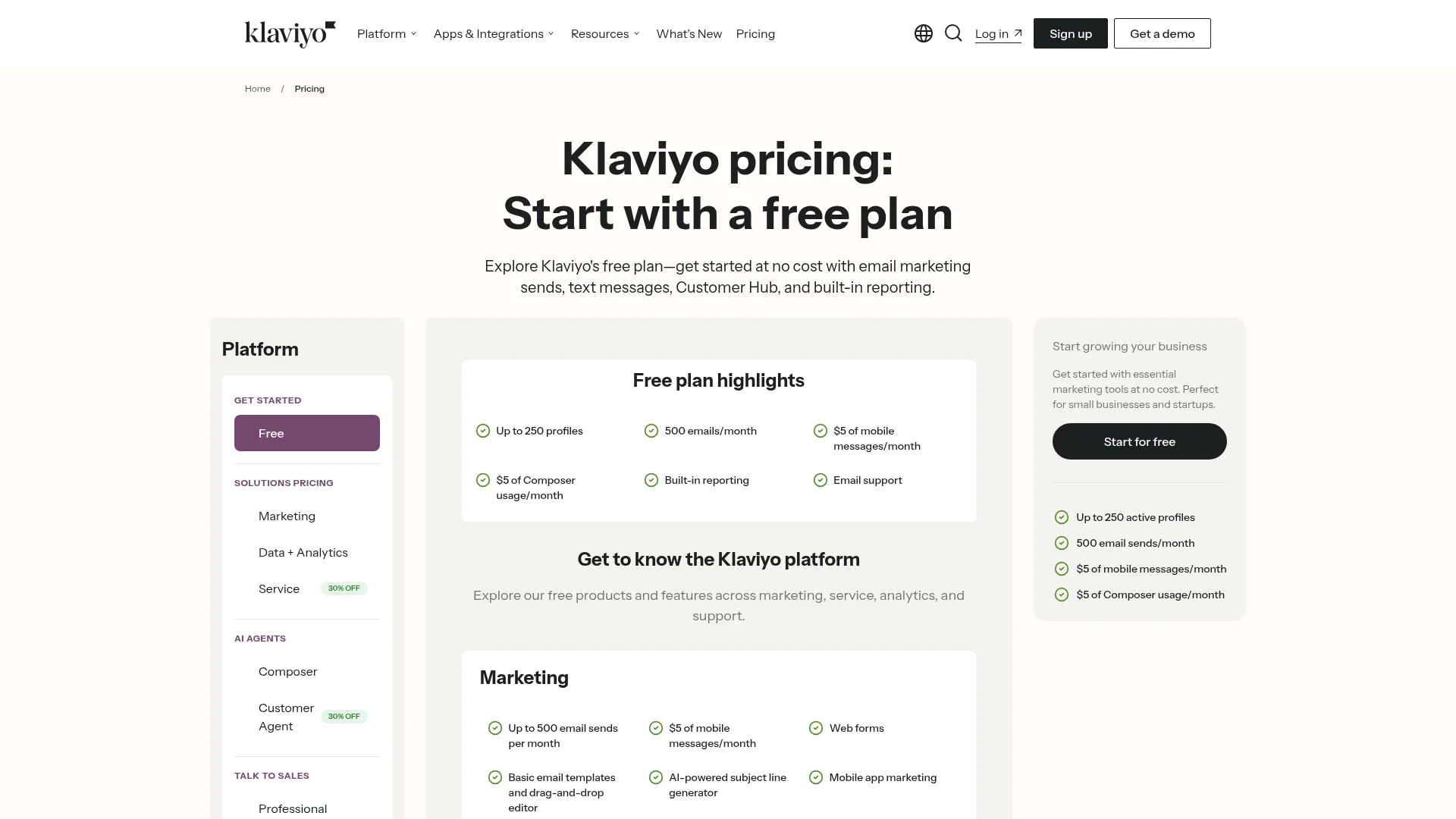
Klaviyo pricing page showing the free plan and profile-based tiers
We're a Klaviyo Master Platinum Partner and a Shopify Partner, so we like both tools for different jobs. Moving to Klaviyo too early might feel like an expensive way to run eCRM, but generally it's the right decision, and you'll see the ROI very quickly. We've never seen a brand move from Shopify Messaging to Klaviyo, to then go back - that alone, says everything.
Shopify Email vs Klaviyo at a Glance
Shopify Email and Klaviyo differ most on pricing model, channels, automation depth, segmentation and setup effort, as this side-by-side comparison shows:
Every difference traces back to one point: one tool sends from your admin, the other runs a customer database that also sends.
One tool sends messages from your admin. The other runs a customer database that also sends messages. Every difference below comes from that.
Shopify Messaging Is a Sender, Klaviyo Is a B2C CRM
Shopify Messaging is a native sending tool inside the Shopify admin, while Klaviyo is a standalone B2C CRM built on customer profiles.
Shopify Email, Now Called Shopify Messaging
Shopify Messagin is used by merchants to send email, SMS and WhatsApp campaigns from the admin.
No app to install. No integration to maintain. Your products, customers and orders are already there.
The newer channels come with conditions. SMS is billed only for messages sent and works in selected regions, and WhatsApp marketing messages can't reach US customers.
Merchants rate it well. The App Store listing shows a 4.7 rating from 3,202 reviews at the time of writing, which tells you plenty of stores find simple is enough.
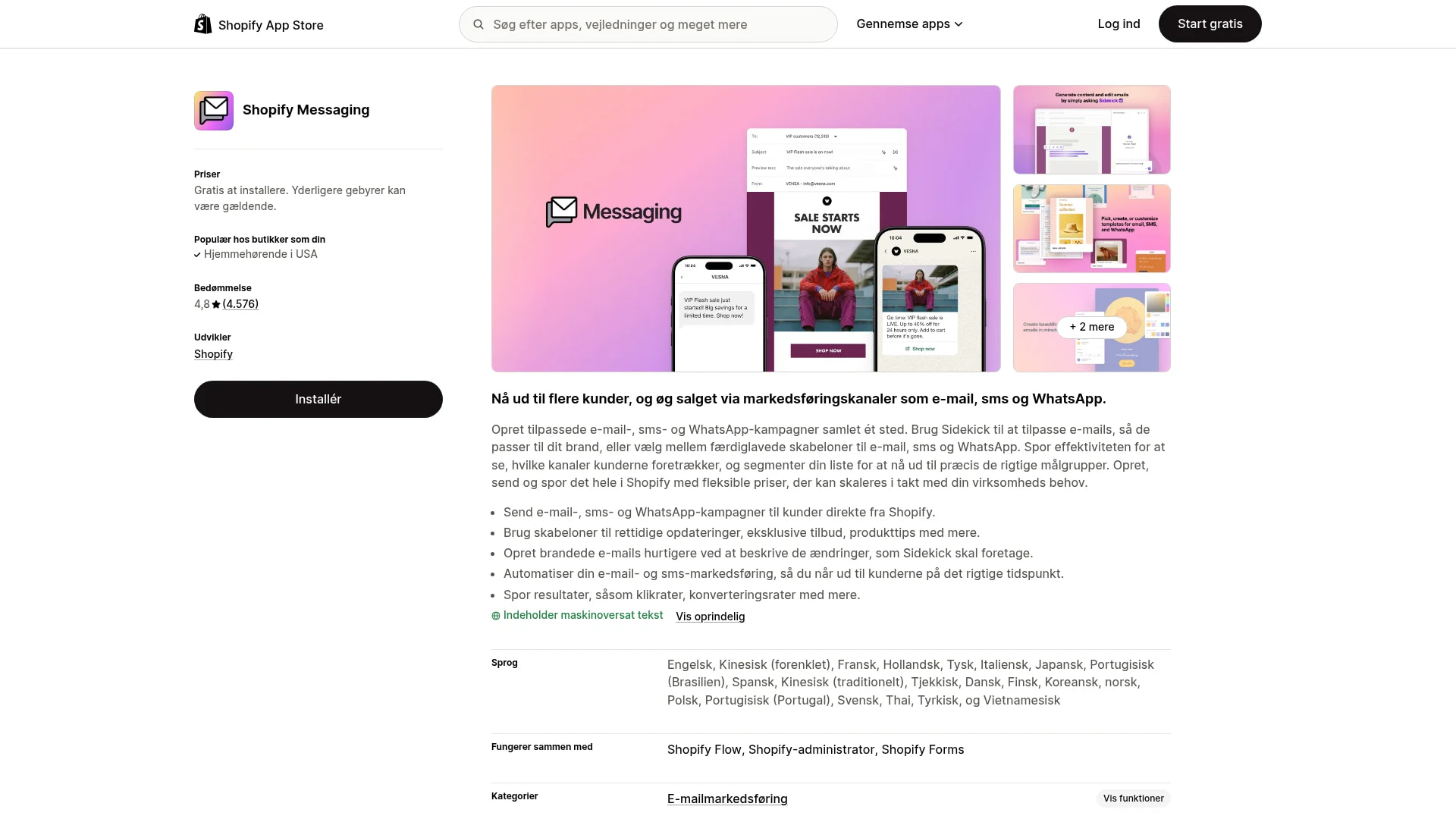
Shopify Email App Store listing with merchant ratings
If that's you, our Shopify Email marketing playbook shows how to get more out of it.
Klaviyo, the B2C CRM Built on Customer Profiles
Klaviyo is a B2C CRM for email, SMS and automation, used by more than 205,000 brands at the end of Q2 2026.
It connects to Shopify as a third-party app and builds a profile for each customer. Orders, browsing, clicks, form answers. One record you can segment on.
It's growing fast too. Klaviyo's Q2 2026 revenue was $370.6 million, up 26% year on year. That matters if you're picking a platform to stay on for years, because a vendor growing at that rate keeps building.
Pricing: Pay per Email Sent or per Profile
Shopify Email pricing is based on emails sent and Klaviyo pricing is based on profiles held, so the cheaper option depends on list size and send frequency.
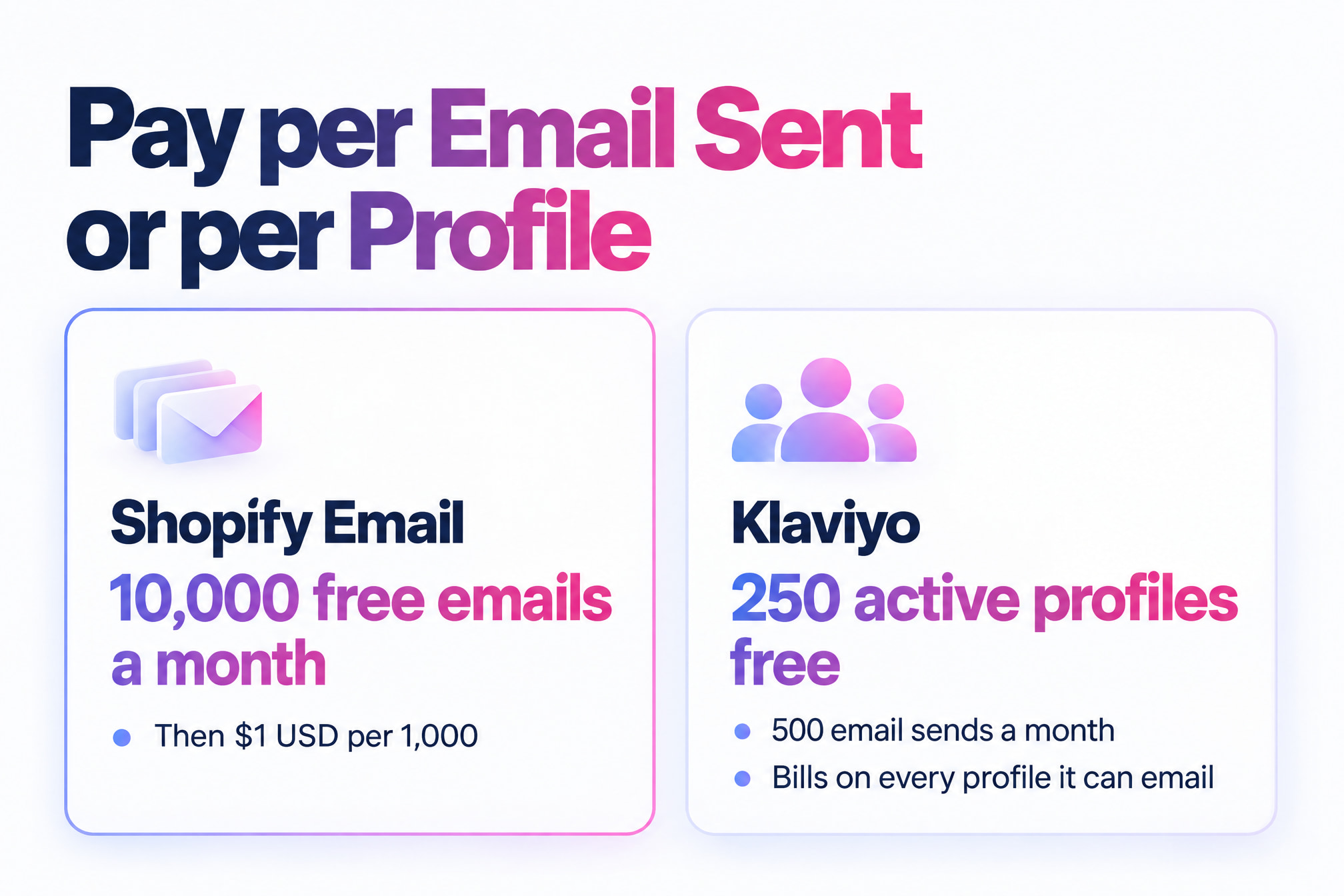
Send volume drives Shopify Email costs; list size drives Klaviyo's, including checkout emails collected without opt-in.
Shopify Email and Shopify Messaging Costs
Shopify Email gives stores on Basic, Grow, Advanced and Plus plans 10,000 free emails a month, then $1 USD per 1,000 up to 300,000. A store emailing 4,000 subscribers twice a month pays nothing.
Bigger senders get a break. Shopify lists lower per-email rates above 300,000 emails a month, so volume alone rarely makes Shopify Email expensive.
Shopify Email marketing page with per-email pricing details
SMS is where UK brands should pay attention. Shopify Messaging SMS costs $0.06 USD per UK message, against $0.012 to the US and $0.025 to Canada. UK texts cost five times the US rate, so every send should earn its place.
Length counts as well. A 200-character message is billed as two, so write short or pay double.
UK sends must also comply with PECR and use an alphanumeric sender name.
Klaviyo's Active-Profile Billing
Klaviyo's free plan covers 250 active profiles, 500 email sends and $5 of mobile messages a month. Fine for testing. Not enough for a trading store.
Klaviyo bills on every profile it can email, regardless of consent status, and that includes checkout emails collected without opt-in. Your bill grows with your list even in months you barely send.
Exceed your tier and Klaviyo moves you to a larger plan automatically unless you suppress profiles at least 24 hours before the next billing cycle.
Sends are rarely the constraint. Klaviyo plans generally allow about 10 times as many monthly sends as profiles, so 1,000 profiles gets roughly 10,000 sends. List size is what moves the bill.
Clean the list every month. Paying to store contacts who never open is the most avoidable cost in eCRM.
Templates, Design and Signup Forms
Shopify Email and Klaviyo both provide drag-and-drop editors and ready-made templates, with Klaviyo adding more control over dynamic content and signup forms.
Shopify Email's templates pull products, prices and images straight from your catalogue. For a launch or a sale, that's quick and on-brand with almost no effort.
Klaviyo goes further. Dynamic product blocks change per recipient, and signup forms can be targeted and A/B tested. That's when design starts doing retention work.
Do two things whichever tool you're on. Build one master template with fonts, colours and footer locked, and start every campaign from it.
Then add one question to your signup form about what people are shopping for. Zero-party data, collected on day one.
Automation and Flows: Abandoned Cart, Welcome and Win-Back
Shopify Messaging's pre-built automations cover abandoned browse, cart, checkout and customer birthday, with anything custom built in Shopify Flow. Klaviyo offers a full flow builder with branching logic for every lifecycle stage.
The core email flows every Shopify store should run are:
- Welcome series: introduces the brand and converts new subscribers.
- Abandoned cart and checkout: recovers people who added items and left.
- Browse abandonment: follows up on products viewed but never added.
- Post-purchase: confirms, educates and sets up the second order.
- Win-back: re-engages customers who've gone quiet.
Shopify Email covers the abandonment end out of the box. A welcome series, post-purchase flow or win-back means building it yourself in Shopify Flow. Doable. Fiddly.
Klaviyo flows branch on behaviour. A repeat buyer skips the discount, and someone who opened but didn't click gets a different follow-up. That logic is what makes email automation and flows feel personal.
Klaviyo's management said on its Q2 2026 earnings call that flows earn 10 times more revenue per message than static campaigns. That's a vendor talking about its own customers, so discount the multiple, but the direction holds. Build flows before you build more campaigns.
Segmentation: Where Klaviyo Pulls Away
Klaviyo's segmentation goes deeper than Shopify Email's, and Shopify's own blog says apps like Klaviyo add advanced segmentation, A/B testing and multichannel campaign management.
Shopify Email segments on store data: what people bought, when, and where they live. Enough to email customers who haven't ordered this year.
Klaviyo segments on behaviour across every touchpoint. Viewed a product twice and didn't buy. Clicked the last two emails. Spent more than your average customer.
It also adds predictive analytics, such as expected lifetime value, churn risk and predicted next order date. Our guide to Klaviyo's AI tools for email marketing covers how those fields work.
The segments that earn their keep are VIPs, first-time buyers and lapsed customers, and each needs a different message. A VIP doesn't need a discount. A first-time buyer needs a reason to order again.
Quick check you can do in five minutes: look at how many customers have ordered more than once. If that group is big enough to matter, segmentation will pay for itself, and these email list segmentation tactics show where to start.
Reporting and the Real Cost of Running Each Tool
Shopify Email reports opens, clicks and sales inside the Shopify admin, while Klaviyo attributes revenue to individual flows, campaigns and segments.
Open rate tells you about subject lines. Revenue per flow tells you whether the programme pays. Only one of those belongs in a board report.
Total cost of ownership is bigger than the pricing page. Setup, flow builds, list hygiene, deliverability and someone to own it all cost time.
Shopify Email switches on in an afternoon. Klaviyo needs integration checks, flows, forms and domain authentication before you send properly.
If nobody on your team owns retention, Klaviyo sits half-built. An expensive dashboard. Budget the hours or stay native until you can.
When to Move From Shopify Email to Klaviyo
Merchants should move from Shopify Email to Klaviyo when their list, product range and team can support segmented lifecycle automation that the native tool makes hard to run.
The quick decision table by store stage is:
Signs You've Outgrown Shopify Email
Shopify Email has been outgrown when working around its limits costs more time than Klaviyo would cost money. The clearest signs are:
- You want different journeys for first-time and repeat buyers.
- You rebuild segments by hand before every campaign.
- Abandoned cart is the only automation earning anything.
- You need A/B tests on flows, beyond subject lines.
- You can't say which flow made which pound.
- You want email and SMS triggered from the same behaviour.
A Five-Step Decision Framework
A five-step decision framework for Shopify Email vs Klaviyo weighs list size, send volume, flow needs, segmentation and team capacity, in this order:
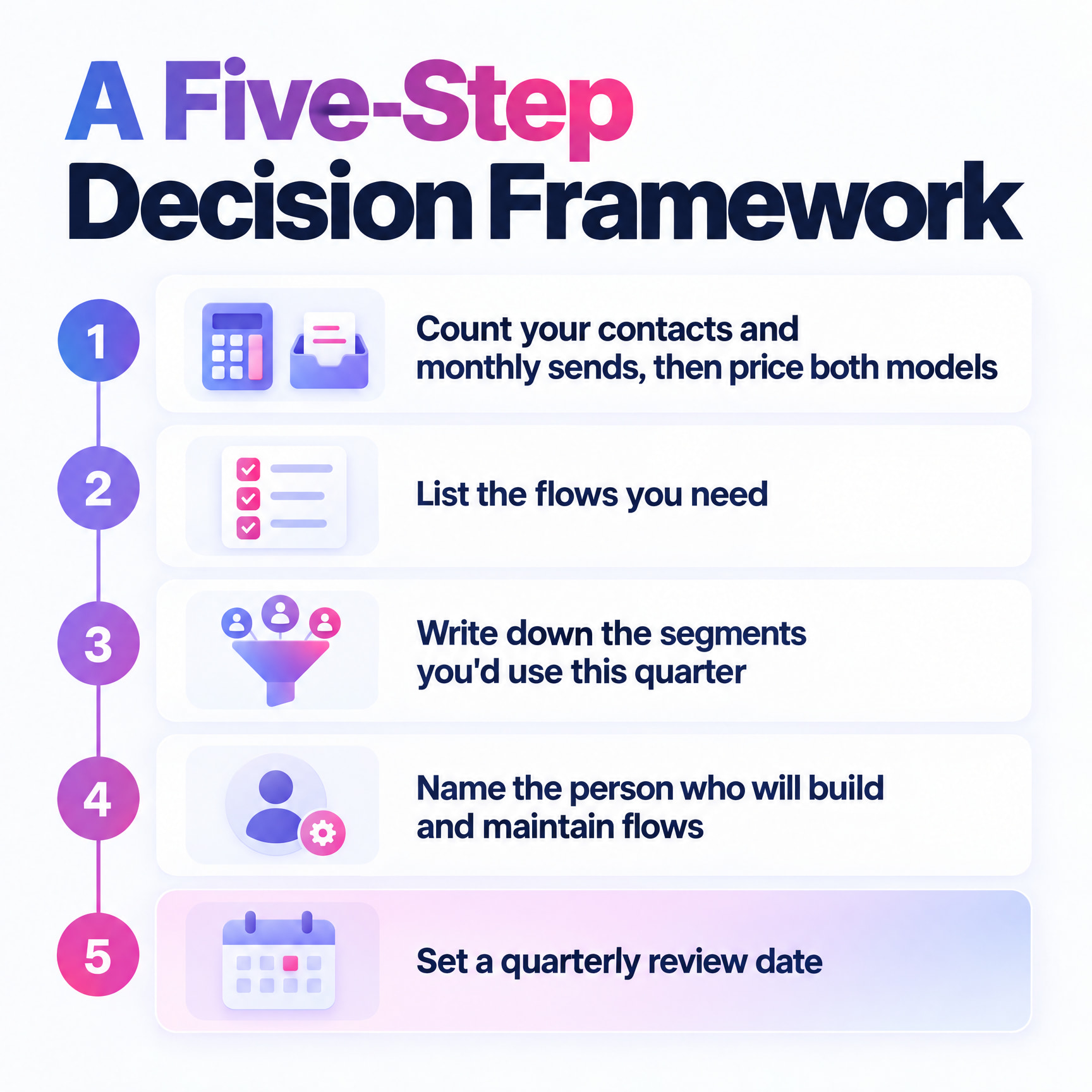
If you can't name the segments or the person who will run the flows, staying on the native tool is the sensible call.
- Count your contacts and monthly sends, then price both models.
- List the flows you need. If it's only abandonment and birthday, stay native.
- Write down the segments you'd use this quarter. If you can't name them, stay.
- Name the person who will build and maintain flows. No name, no Klaviyo.
- Set a quarterly review date and run steps one to four again.
Migrating to Klaviyo Without Duplicate Abandoned Cart Emails
Migrating from Shopify Email to Klaviyo means switching off Shopify's abandoned cart and checkout automations when Klaviyo's flows go live, or customers get two recovery emails.
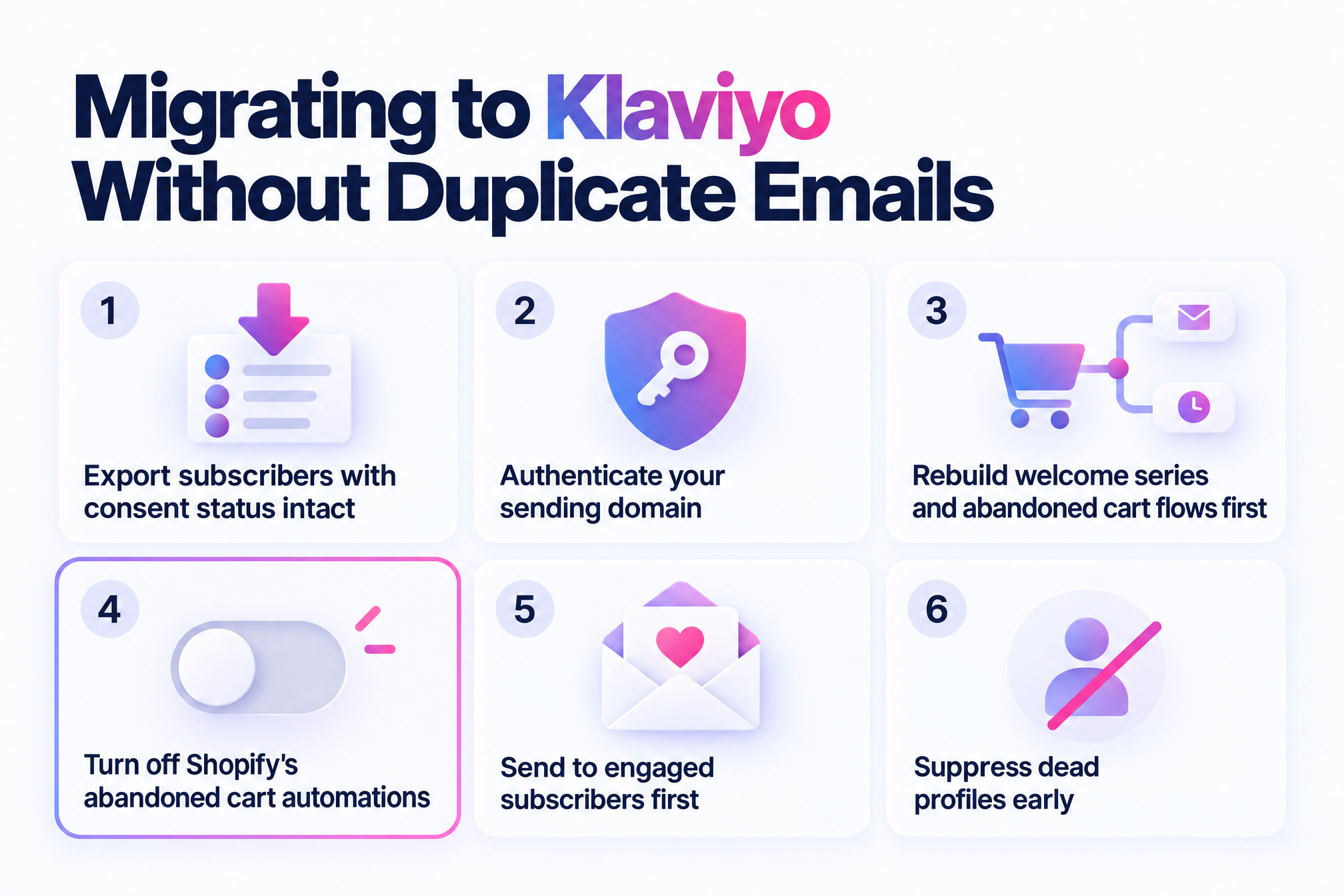
Test the new cart flow with a real checkout before switching the old one off, so customers never get two recovery emails.
Deliverability is where rushed migrations go wrong. The migration steps, in order, are:
- Export subscribers from Shopify with consent status intact.
- Authenticate your sending domain with DKIM, SPF and DMARC.
- Rebuild the welcome series and abandoned cart flows first, then browse abandonment, post-purchase and win-back.
- Turn off Shopify Messaging's abandoned cart and checkout automations the day Klaviyo's go live.
- Send campaigns to engaged subscribers first, then widen the audience over a few weeks.
- Suppress dead profiles early, because Klaviyo upgrades accounts that exceed their profile limit.
Test the new cart flow with a real checkout before switching the old one off. Two cart emails in an hour looks careless.
Quick Answers on Shopify Email and Klaviyo
Does Klaviyo work with Shopify?
Klaviyo works with Shopify as a third-party app, and Shopify's blog names Klaviyo among apps adding A/B testing and advanced segmentation. Install the app, connect your store, and Klaviyo builds profiles from your customer and order data.
What are Klaviyo's weaknesses?
Klaviyo's main weaknesses are cost and complexity, because it bills on every profile it can email, opted in or not. For most stores, this shouldn't be seen as a blocker - Klaviyo is a B2C CRM, so you should bring all of your customer data into Klaviyo.
Who is Klaviyo's biggest competitor?
Klaviyo's most direct competitor for a Shopify merchant is Shopify Messaging, because it's already installed and includes 10,000 free emails a month on most plans. Omnisend and MailerLite are the other names, compared in our roundup of the best email marketing platforms for Shopify.
The Verdict: Start Native, Graduate to Klaviyo
The verdict on Shopify Email vs Klaviyo is that for 95% of stores, Klaviyo wins. Especially if your store is driving over $500k of revenue. It's proven time and time again, that biting the bullet early and moving to Klaviyo always pays off.
Priority order matters more than platform. Run abandoned cart and browse abandonment now, on whichever tool you have. Add a welcome series and post-purchase flow next, then win-back.
Today, check two numbers: how many contacts you hold and what your automations earned last month. Within seven days you should have Klaviyo's price at your list size and a written list of flows you'd build.
When migrating, you can use our guide to improving customer retention for Shopify stores to decide what to build first.